Gallery Wall Ideas for a Hallway: 14 Layouts for Narrow and Long Halls
Gallery wall ideas for a hallway, from a single row of frames to picture ledges and an end-wall stack: which layout suits a narrow, long or dark hall, how high to hang, and how to keep frames straight where people brush past.

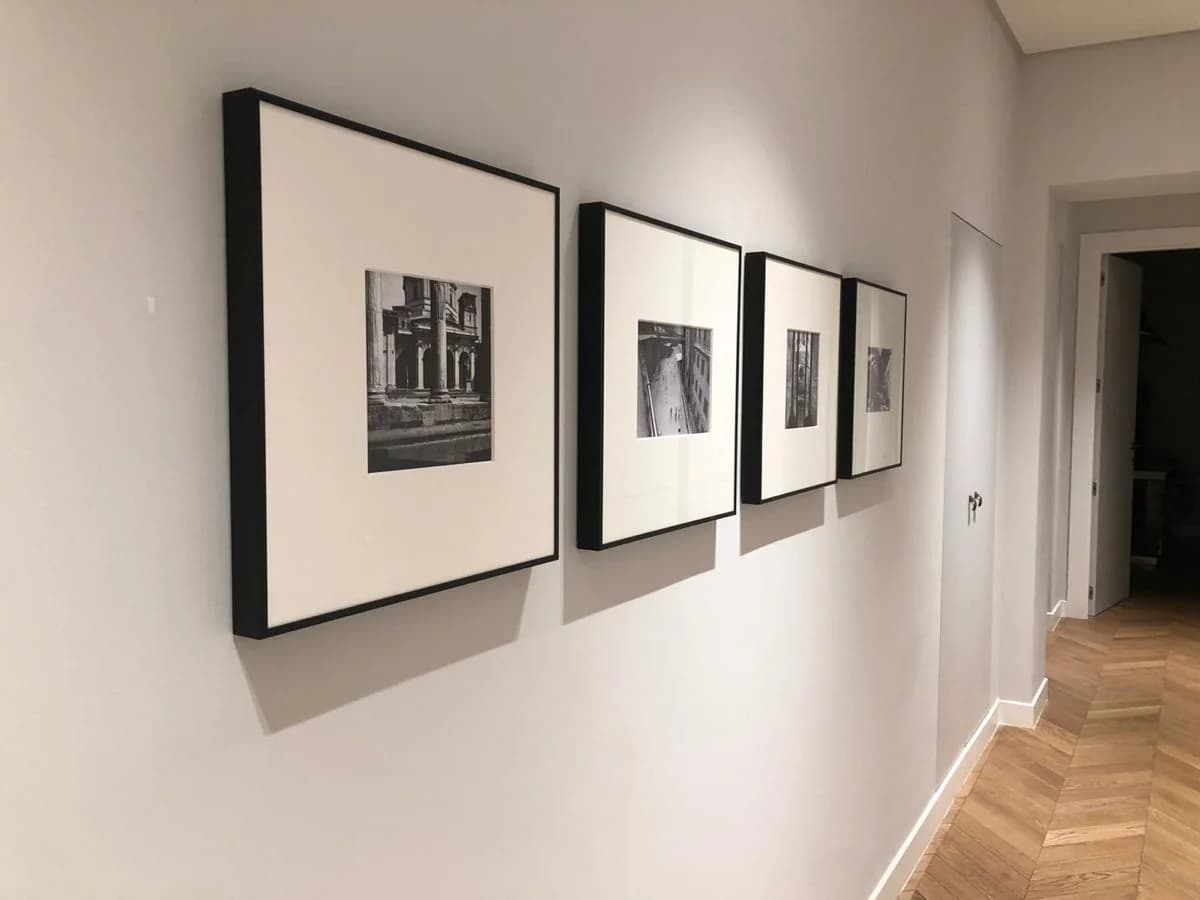
In this guide · 22 sections
The best gallery wall ideas for a hallway accept what a hallway is: a place you walk through, seeing the wall at an angle and from close up. That favors orderly layouts, a single row, a grid or a line of ledges, over a sprawling cluster, and it favors slim frames hung flat. In a narrow hall, hang on one wall only and keep the pictures at eye level; in a long one, repeat the same frame down its length so the wall reads as one piece.
Below are 14 ideas grouped by layout, ledges, what to frame, and light and color, with a table to match the layout to your hall. For coats, shoes and keys, which need solving before art does, see our small apartment entryway ideas.
Which Layout Suits Which Hallway
| Hallway | Layout that works | Why | Avoid |
|---|---|---|---|
| Narrow (two people cannot pass) | One row at eye level, one wall only | Seen at a sharp angle; a line stays readable | Deep frames, ledges at shoulder height |
| Long and plain | A grid or a repeated row down the full length | Repetition turns length into a feature | One small cluster lost in the middle |
| Short, with a blank end wall | A vertical stack or one large piece on the end wall | The end wall is the only one you face | Filling the side walls as well |
| Wide, or a landing | An organic cluster, ledges, a console below | There is room to step back | Pictures hung too high above furniture |
| Dark, no window | Pale mats, a mirror in the mix, picture lights | Bounces what light there is | Dark frames on a dark wall, shiny glass facing a bulb |
| Rental | Ledges on few fixings, or adhesive strips | Fewer holes; easy to change | Heavy glazed frames on strips beyond their rating |
Gallery Wall Ideas for a Hallway: Layouts
1One row at eye level
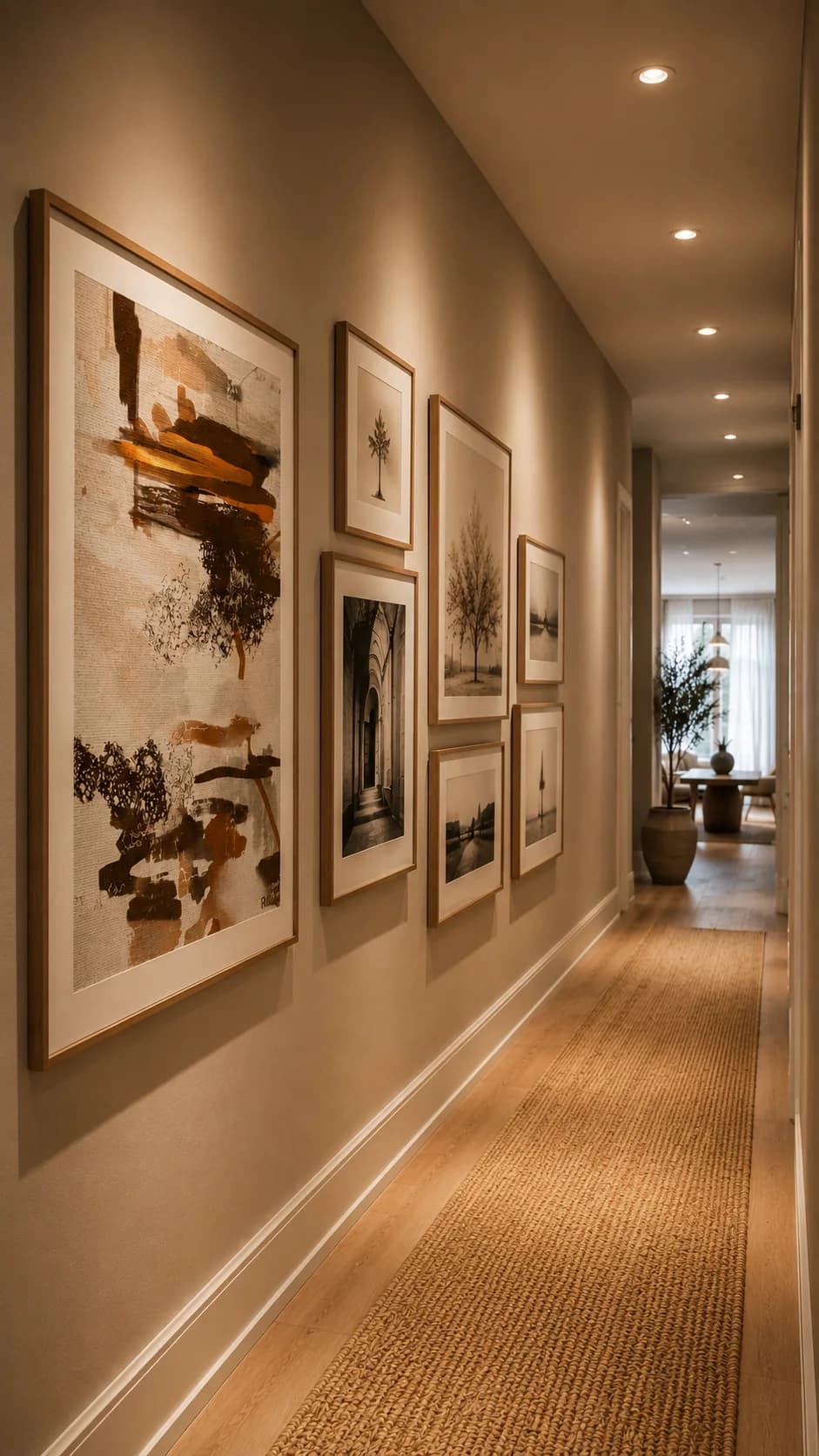
The simplest hallway gallery is a single horizontal row of same-size frames. As common guidance, the middle of each picture sits at about eye level for a standing adult, roughly 145 to 150 cm from the floor, with equal gaps of a few centimeters between frames. Five to seven frames in one finish make a long wall look intentional. Mark a level line with painter's tape before you make a hole.
2Two rows: a long, low grid
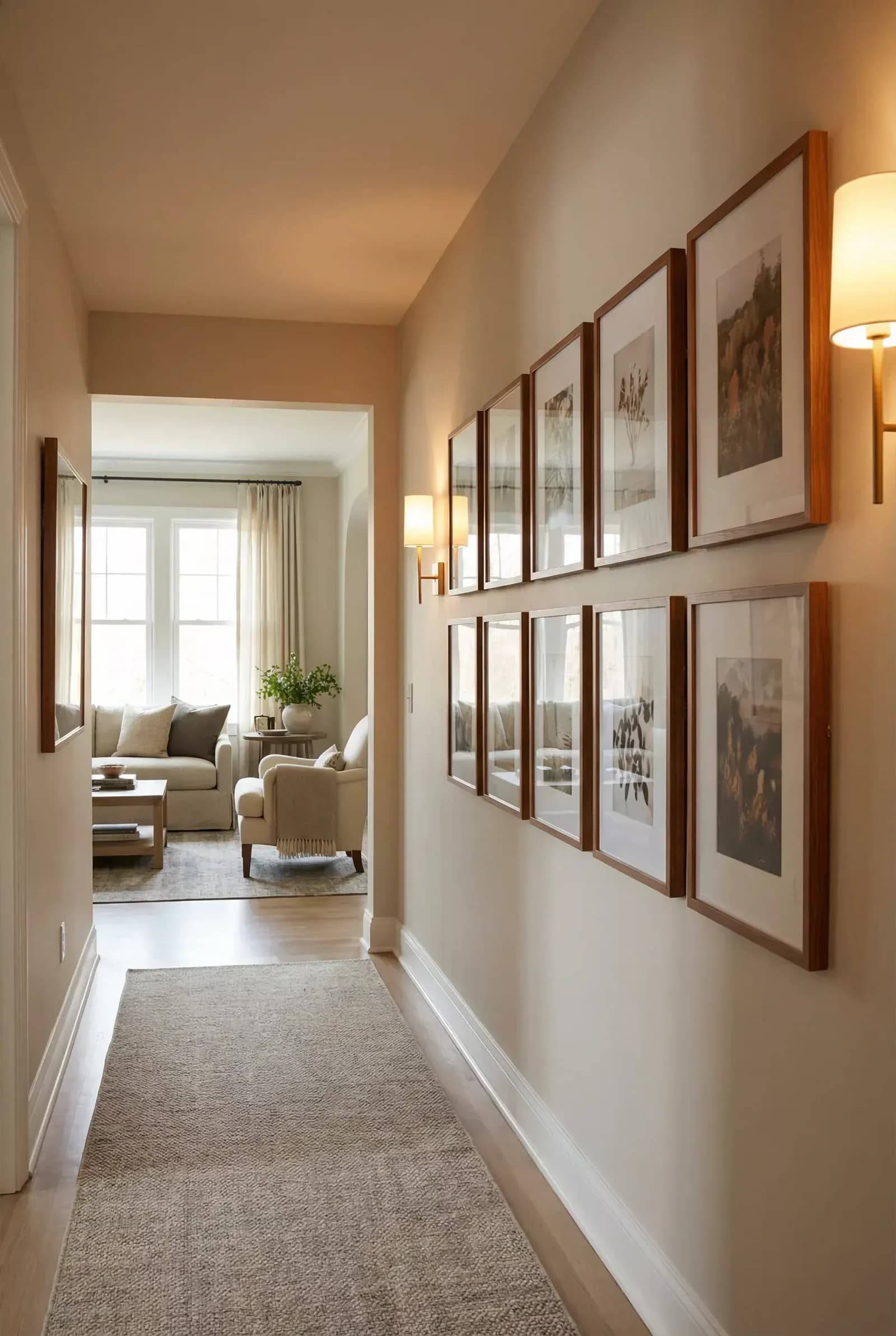
Double the row. Two rows of five identical frames form a wide rectangle that fills a wall between two doorways. Line up the outer edges of the grid with something in the architecture, such as a door frame or a wall light, so it looks anchored. Wood frames with wide white mats keep it warm and light.
3Mirror the grid on both walls, if the hall is wide enough
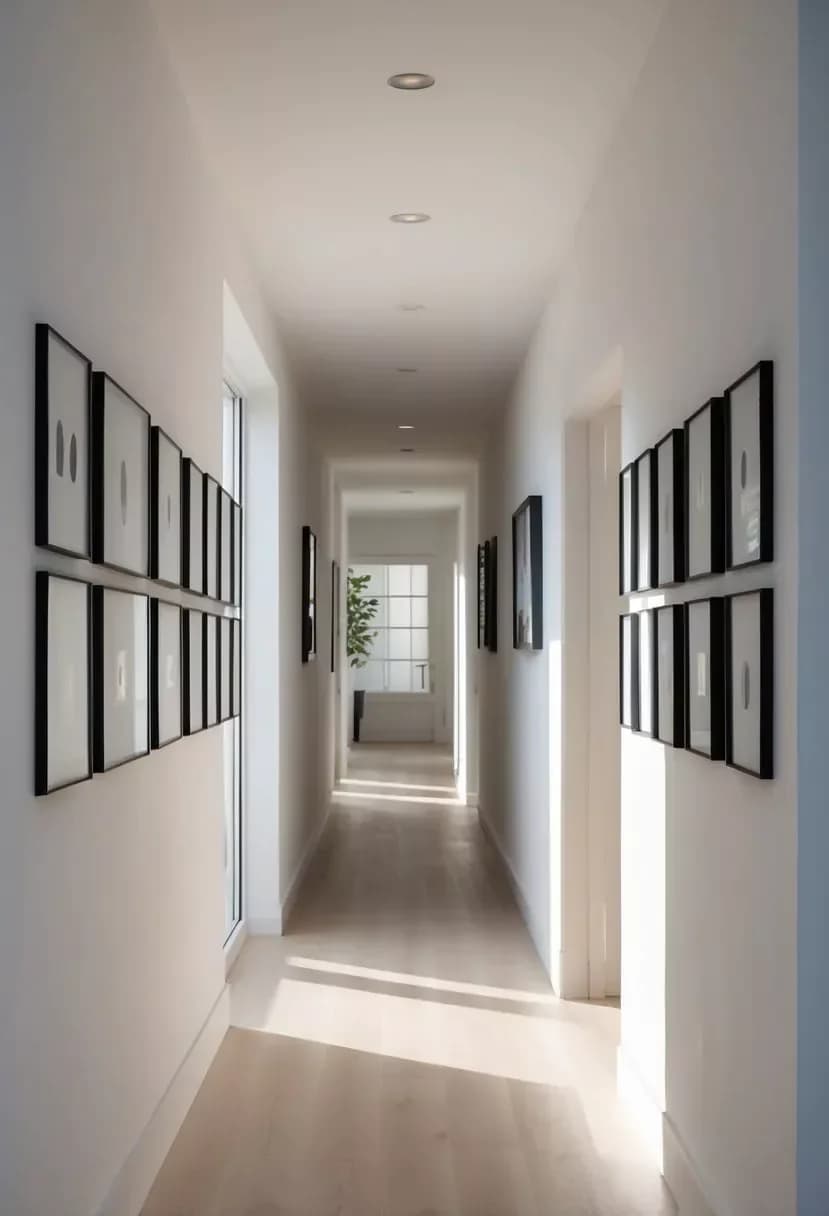
In a hall where two people can pass comfortably, the same grid on facing walls gives a formal, gallery-like effect. Use thin frames and keep both grids at exactly the same height. In a narrow hall, do not do this: frames on both sides make the passage feel tighter and get knocked from both shoulders.
4A vertical stack on the end wall
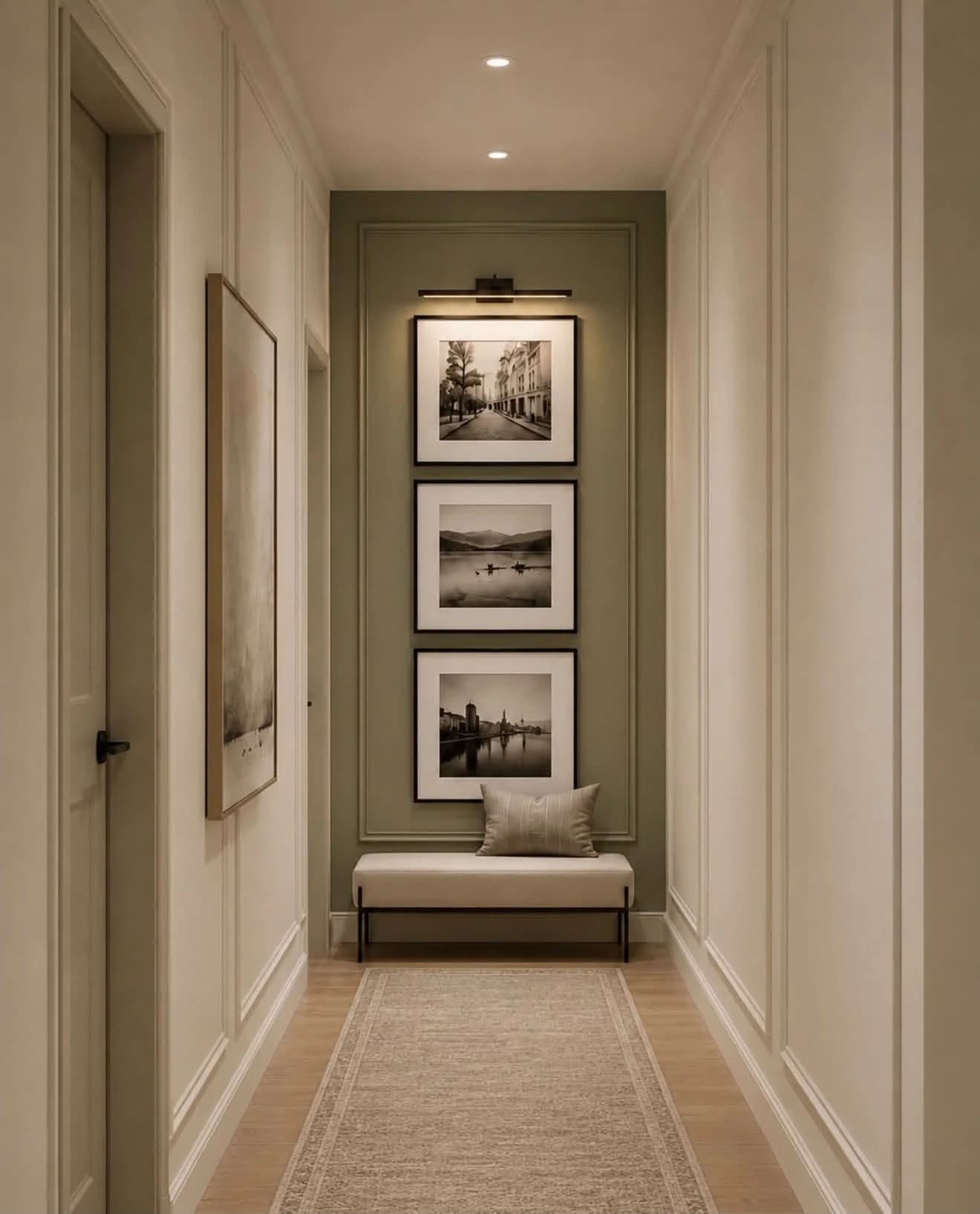
The wall at the end of a hallway is the only one you look at head-on, and the best place for art in a short hall. Stack three frames of the same size vertically, centered on the wall, and put a narrow bench or stool beneath. Painting that wall a different color from the sides, and adding a picture light above, turns a dead end into a destination.
5One large piece, then smaller ones
Start with one big artwork near the entrance to the hall and follow it with smaller frames in pairs. The large piece sets the scale; the small ones lead the eye down the corridor. Keep one thing constant, such as the frame color or the color range of the art, so the mix of sizes still belongs together.
6An organic cluster around a mirror
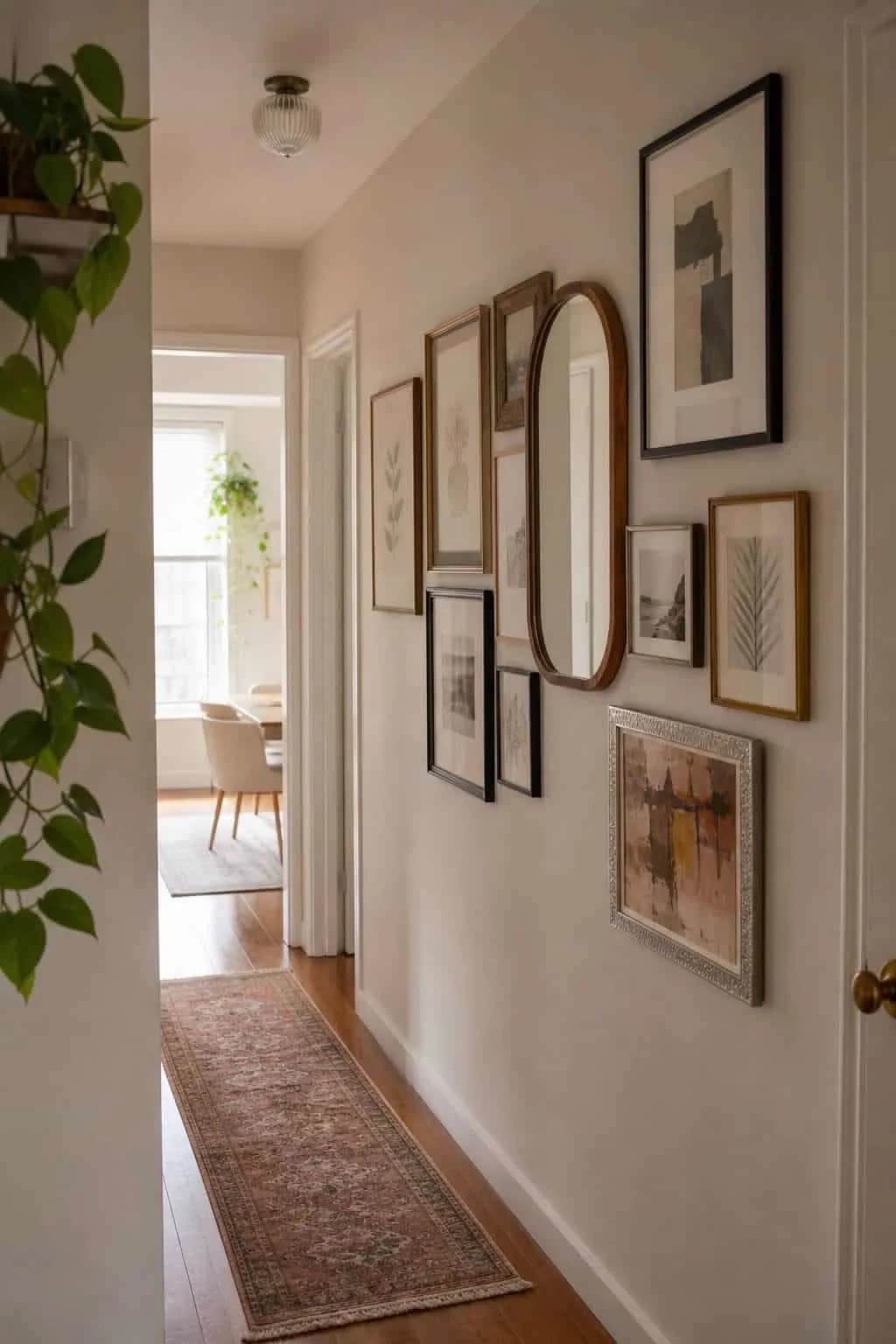
Where the hall widens, at a landing or beside a doorway, a looser group works. Put a mirror in the middle and arrange frames of different sizes around it, keeping the gaps between them roughly equal. The mirror adds light and breaks up the rectangles. Lay the whole arrangement on the floor first and photograph it before hanging.
Picture Ledges
7One long ledge under hung frames
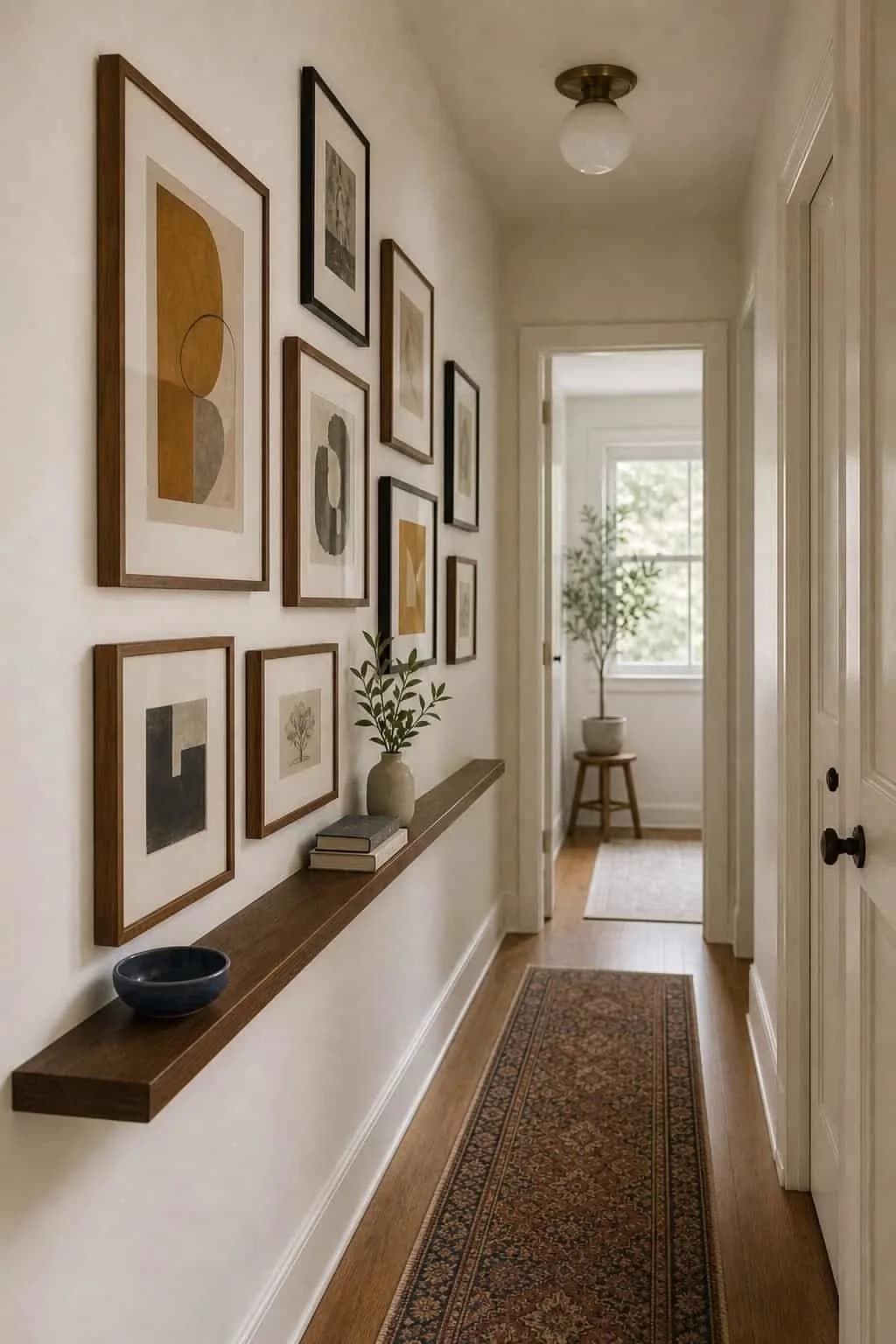
Hang a group of frames and fix a long, shallow wooden shelf below it. The ledge gives the arrangement a base line and holds one small vase and a couple of books. Keep the shelf shallow, around the depth of a paperback, so nobody catches a hip on it.
8Prints and vases along a rustic ledge
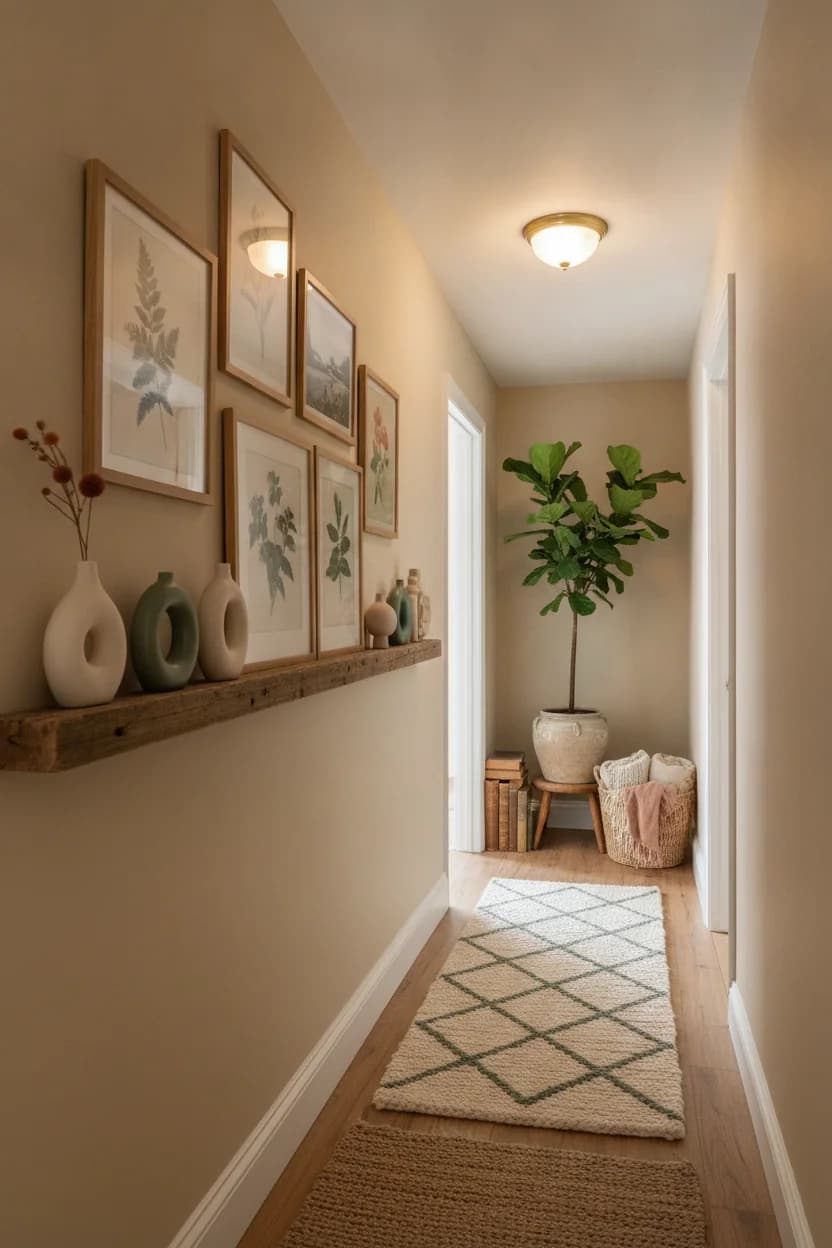
A single reclaimed-wood ledge with a few ceramic vases, and botanical prints hung in a rising line above it, suits a hall with warm walls. Because the prints are hung and only the vases stand on the ledge, nothing can slide off when a door slams.
9Three or four stacked ledges
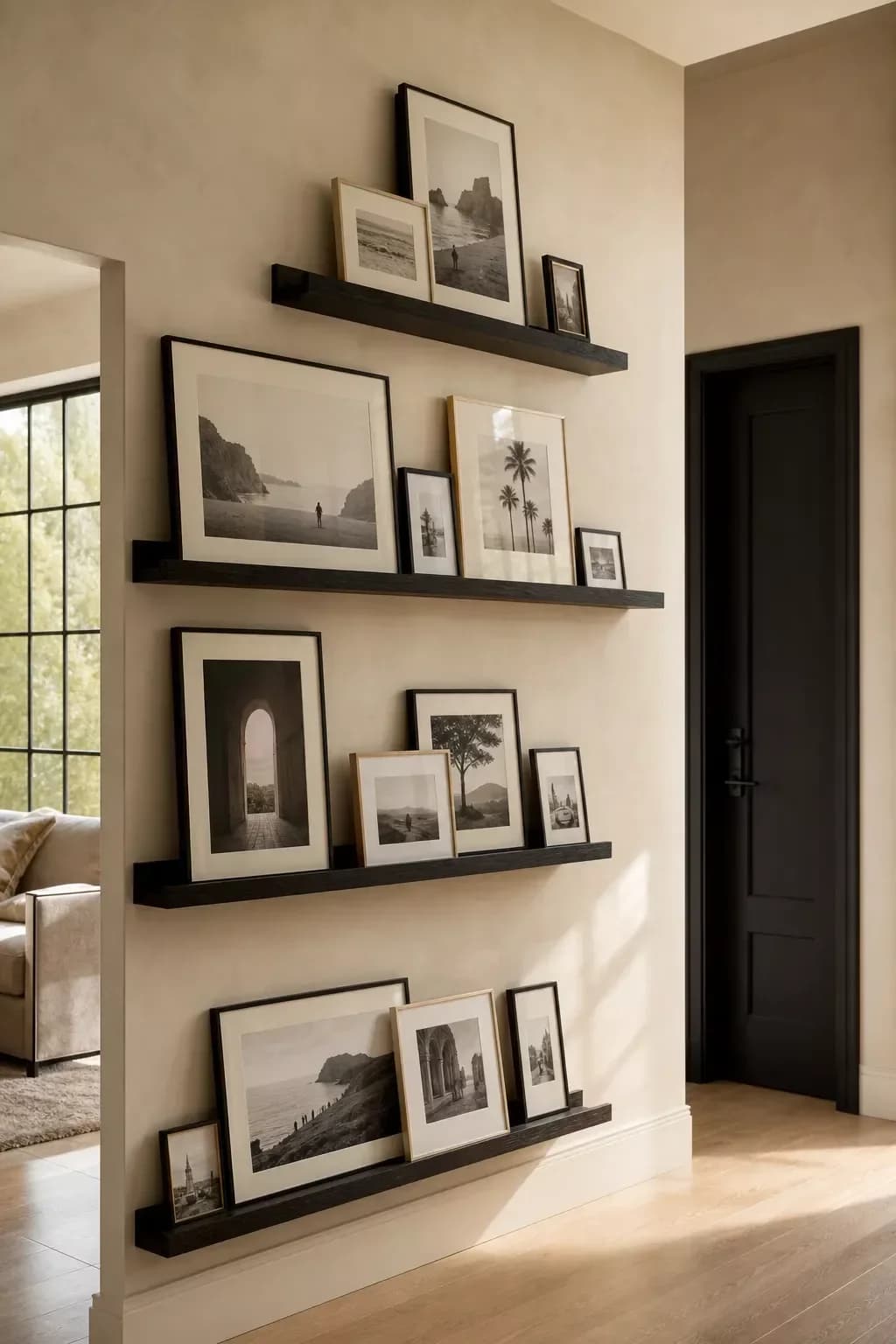
Several ledges, one above another, let you lean and overlap frames of different sizes and change them whenever you like, with only the ledge fixings in the wall. Black ledges with black-and-white landscape photographs in black, white and wood frames look sharp against a pale wall. Put the largest frames at the back and overlap smaller ones in front.
What to Frame
10Black and white photographs
Converting photos to black and white is the quickest way to make unrelated pictures look like a set: travel shots, buildings, landscapes, old family prints. Print them the same size with wide white mats. In a hallway, where people stand close, wide mats give each picture room.
11Family photos, edited down
A hallway is the traditional place for family photos because it is private enough and passed every day. Three things keep it from looking chaotic: the same frame throughout, the same treatment (all black and white, or all color), and fewer, larger prints. Choose a dozen you love and leave room to add.
12Art that costs almost nothing
Pages from an old botanical book or atlas, children's drawings, postcards, pressed leaves, a piece of fabric. Public-domain images from museum and library collections can be printed at any size. What makes cheap art look good is the mat and the consistency of the frames, and secondhand frames can be painted to match. We describe the same approach for a bedroom wall in our boho bedroom ideas on a budget.
Light and Color
13Light the pictures, not the floor
Most hallways have a ceiling light that puts glare on glass and leaves the art dull. Picture lights above the frames or wall lights between them light the wall itself. Plug-in and rechargeable versions exist for halls with no wiring in the right place; our guide to lighting without ceiling lights covers them. Non-reflective glazing or no glazing at all reduces glare further.
14A mirror opposite, panelling below
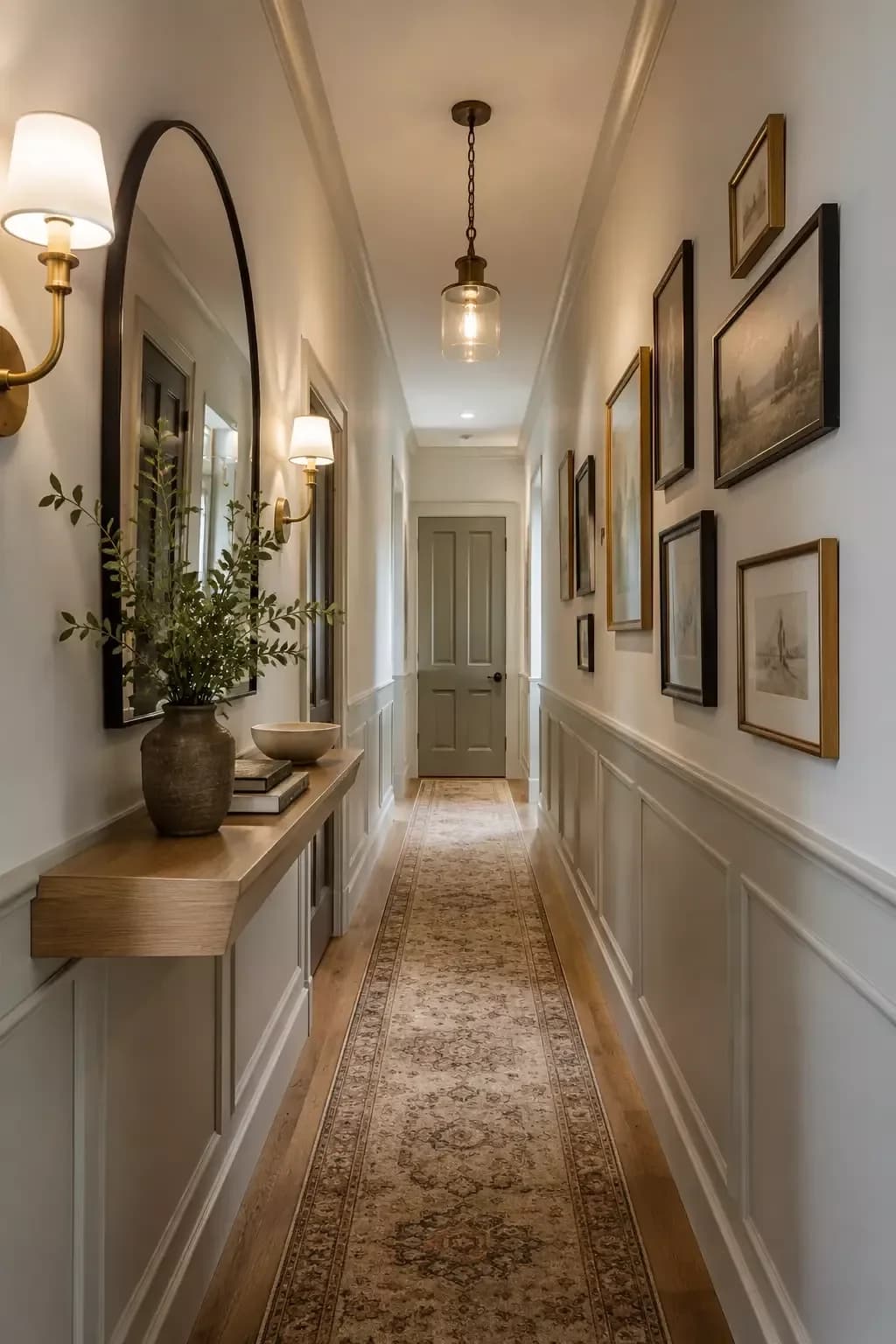
In a narrow hall, hang the gallery on one wall and a large mirror on the other, above a shallow shelf. The mirror reflects the frames, so you get the look of two decorated walls with only one that sticks out. Panelling or a darker painted band on the lower wall takes the scuffs from bags and shoes and gives the frames a line to sit above.
Wall Color Behind the Frames
- Warm white or cream: the default. Every frame color works, and the hall stays bright.
- A mid color such as sage, clay or grey-blue: white mats stand out and the hall feels furnished. Good on an end wall.
- A dark color: dramatic with brass or wood frames and picture lights; only where there is some light.
- The same color on wall and woodwork: calms a hall with many doors so the frames are the only pattern. The method is in our guide to color drenching a living room.
How to Plan and Hang It
A few practical notes for hallways in particular:
- Hang flat. Two hooks per frame, or one hook plus adhesive bumpers or a dab of removable putty at the lower corners, stops frames tilting when someone brushes past.
- Keep gaps equal. A few centimeters between frames, the same everywhere, matters more than the exact number.
- Mind door swings and switches. Leave a clear margin around both.
- In a rental, adhesive hanging strips hold light frames on smooth painted walls. Follow the weight rating and press time on the pack; our guide to hanging decorations without nails explains which hooks hold on which surface.
When the season changes, the gallery wall can stay as it is while the table or bench below it changes; see our Christmas entryway decor ideas for the December version.
FAQ
How do you arrange a gallery wall in a hallway?
Choose an orderly layout: one row or a grid of same-size frames at eye level, with equal gaps. Plan it with paper templates on the wall first, then hang from the center outward.
How high should pictures hang in a hallway?
As common guidance, with the center of the picture or of the whole group at standing eye level, around 145 to 150 cm from the floor. Above a console or bench, leave a hand or two of space.
What is the best gallery wall for a narrow hallway?
A single row of slim frames on one wall, hung flat, with a mirror on the opposite wall if you want more. Avoid deep frames and ledges at shoulder height.
Are picture ledges good for a hallway?
Yes, if they are shallow and above or below shoulder height. They need few fixings and let you swap pictures without new holes. Use them where the hall is wide enough.
How do I light a gallery wall in a hallway?
With picture lights above the frames or wall lights between them. Plug-in or rechargeable lights avoid wiring. Non-reflective glazing cuts glare from ceiling lights.
Should hallway gallery frames all match?
In a narrow or long hall, yes: matching frames make the wall read as one piece. In a wider space you can mix frames if one thing stays constant, such as the mat or the color of the art.