How to Style a Bookshelf (With or Without Books): A Step-by-Step Method
How to style a bookshelf in seven steps: empty it, set a palette, place the large pieces, arrange books upright and in stacks, layer art and objects, leave gaps and light it. With versions for many books, few books and none.

In this guide · 10 sections
Here is how to style a bookshelf in one sentence: empty it, put back the biggest things first, arrange the books in a mix of upright rows and flat stacks, add a few objects at different heights, and stop while there are still gaps. The gaps matter as much as the objects. A shelf that is about two thirds full looks arranged; a shelf that is full looks like storage.
The method below works for a single bookcase, a wall of built-ins or two floating shelves, and it adapts to how many books you own: a real library, a few dozen, or none. It takes an afternoon and usually needs nothing new.
The Method in Seven Steps
1. Empty every shelf. You cannot style around what is already there. Dust, and sort everything into three piles: books, objects, and things that do not belong on show (chargers, paperwork, half-used candles). The third pile goes into a basket or a cupboard.
2. Choose a palette. Look at the objects pile and pick two or three colors or materials that repeat: for example white ceramics, black accents and wood; or green, brass and cream. Anything loud that does not fit moves to another room. This single step does most of the work.
3. Place the largest pieces first. Big vases, baskets, a large framed print, a lamp. Spread them across the unit in a zigzag: top left, middle right, lower left. They are the anchors, and everything else fills in around them.
4. Add the books. Some upright, some in flat stacks of two to five. Alternate from shelf to shelf: if the books stand on the left on one shelf, stand them on the right on the shelf below. Put the heaviest, tallest books low.
5. Layer art and smaller objects. Lean a frame against the back of a shelf and stand a small object in front of it. Put a bowl or a candle on top of a flat stack of books. Group small things in threes; one small thing alone looks lost.
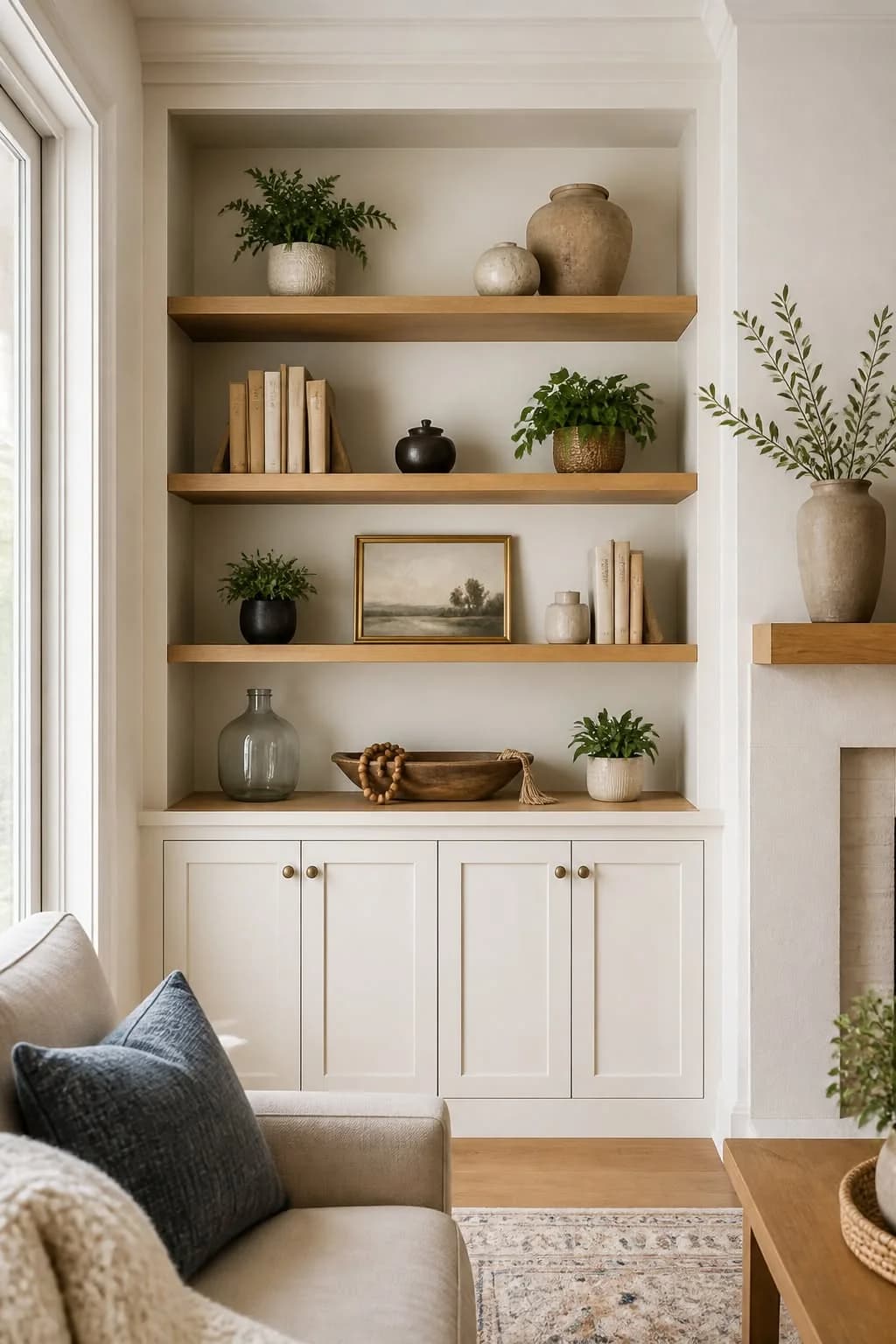
6. Add something living. One trailing plant near the top, one upright plant lower down. Dried stems or branches in a vase count where there is no light.
7. Step back and remove. Stand across the room, or take a photo with your phone, which shows imbalance better than your eye does. Take away two or three things. Check that no shelf is completely full and no shelf is completely empty.
What Goes on Which Shelf
| Shelf | Best for | Why |
|---|---|---|
| Top | Large, simple, light things: a big vase, a basket, a trailing plant | Seen from below and from far away; small objects vanish up there |
| Eye level | The best pieces: art, a favorite object, the neatest books | This is where people look first |
| Middle | Books mixed with objects; a lamp | The working shelves |
| Lower | Heavy books, flat stacks, larger boxes | Visual weight belongs low, and so does real weight |
| Bottom | Baskets or closed boxes | Hides clutter, and survives feet, vacuum cleaners and children |
How to Arrange the Books
Books are the best decoration a bookshelf has, and they need less arranging than people think.
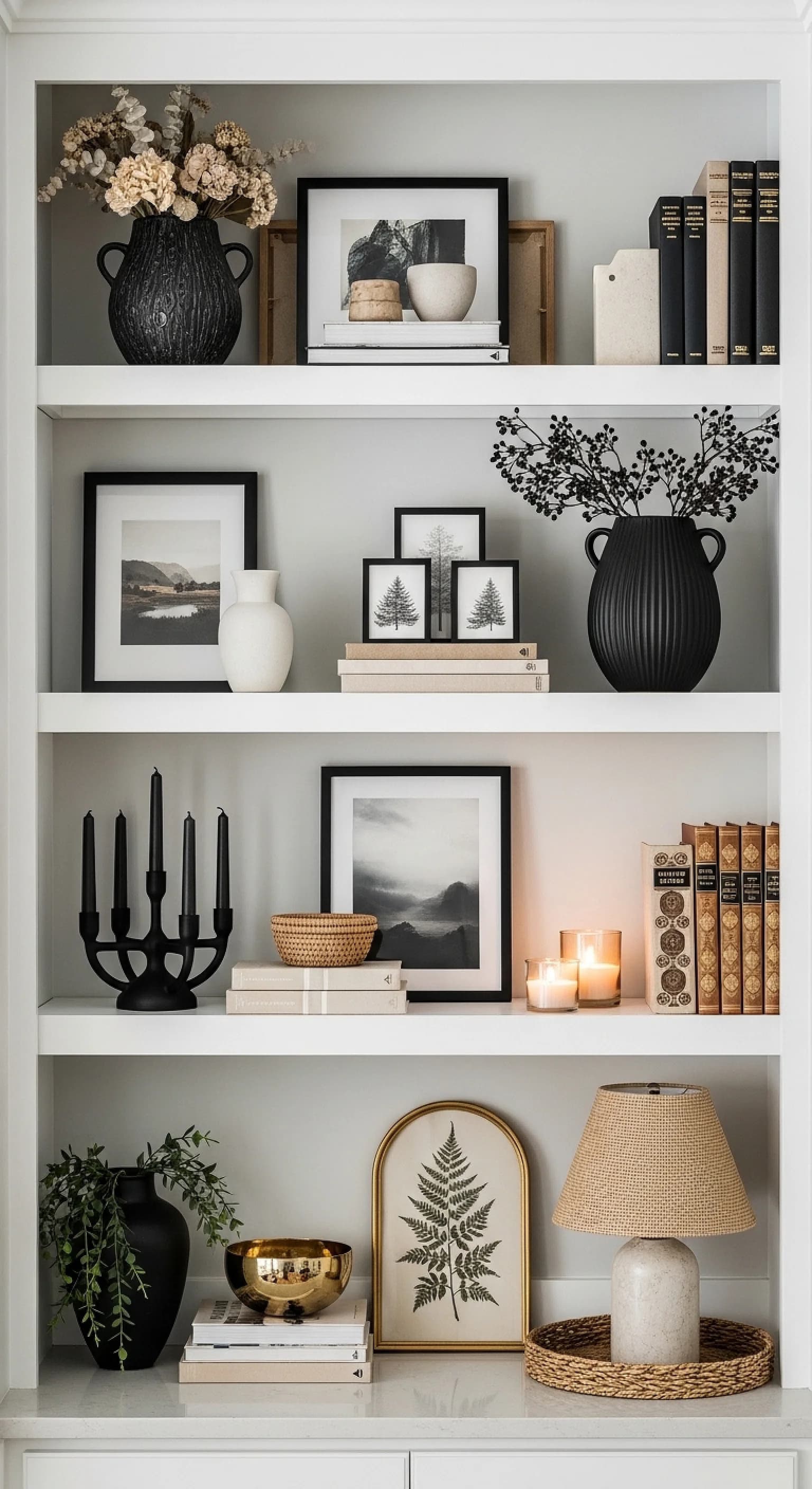
- Upright and flat. A row of upright books, then a flat stack, then a gap, reads as a rhythm. A flat stack also makes a small plinth for an object.
- Pull spines to the front edge. Line the spines up at the front of the shelf, not pushed to the back. It looks tidier at once and stops dust settling in front.
- Group by size, loosely. Tall with tall. A skyline that steps up and down is restless.
- Color is optional. Sorting by color looks striking, and makes books harder to find. A middle way: keep subjects together, and within each group put similar colors side by side.
- Bright jackets. If the covers fight your palette, remove dust jackets from hardbacks; the cloth beneath is usually a quieter color. Turning books spine-in gives a neutral wall of pages but makes them unusable. Do it only with books you never open.
- Bookends. A heavy object, a stone, a small sculpture or a flat stack laid against the row all work as bookends.
The Proportions That Make It Look Styled
There is no fixed formula, but common guidance runs close to this: about half to two thirds of the space for books, about a quarter for objects and art, and the rest left empty. With many books the object share shrinks; with few, it grows. What should not shrink to nothing is the empty share.
Three habits help the eye:
- Triangles. Repeat a color or material three times across the unit so the three points form a triangle: three white vases, three brass pieces, three plants.
- Odd numbers. Groups of three or five small objects, at different heights.
- Front and back. Every shelf should have something at the back (a frame, a tall vase, a row of books) and something in front of it.
If You Have a Lot of Books
A working library should look like one. Fill most shelves with upright books, and give the eye a rest in three ways:
- Leave one or two open bays at eye level for a lamp, a framed picture or a plant.
- Lay a flat stack at the end of every second or third row.
- Keep the bottom shelf for the largest volumes laid flat, or for baskets.
Lighting makes a wall of books look intended. A small lamp on a shelf, or stick-on LED strips under each shelf, adds depth in the evening.
How to Style a Bookshelf Without Books
With no books, a shelf loses its easy source of mass and repetition, so something else has to provide both.
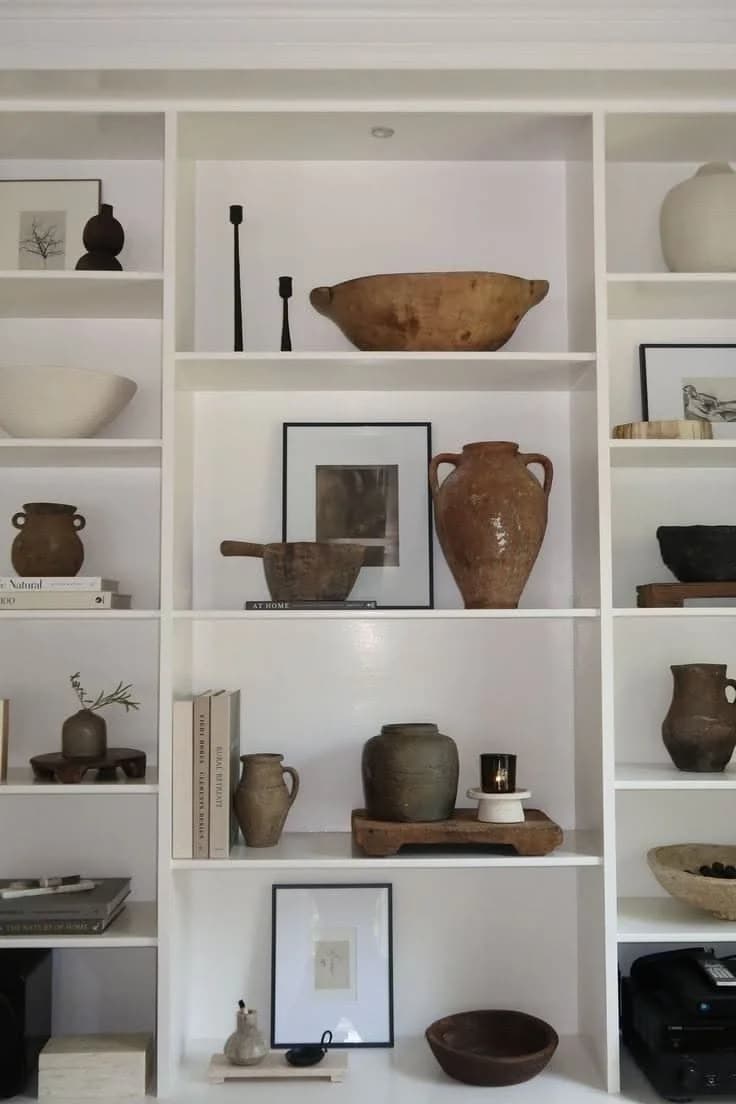
- Choose a collection. Pottery, baskets, glass, wooden bowls: many pieces of one kind, in two or three related colors. A shelf of old jugs and bowls in earthy tones reads as calm because the pieces are relatives.
- Use fewer, larger objects. One large pot on a shelf looks confident. Ten small ornaments look like a shop.
- Vary shape, not color. Tall beside wide, round beside angular, matte beside glazed.
- Add flat things for the back layer. Framed prints, a small mirror, a tray stood on edge.
- Use plinths. Without flat stacks of books, lift objects on wooden boxes, slabs of stone or upturned bowls to vary the height.
- Leave whole sections empty. With no books, empty space is what stops the unit looking like a display cabinet.
Closed storage also counts. Matching baskets or boxes along the bottom two shelves hold everything that is useful and not attractive.
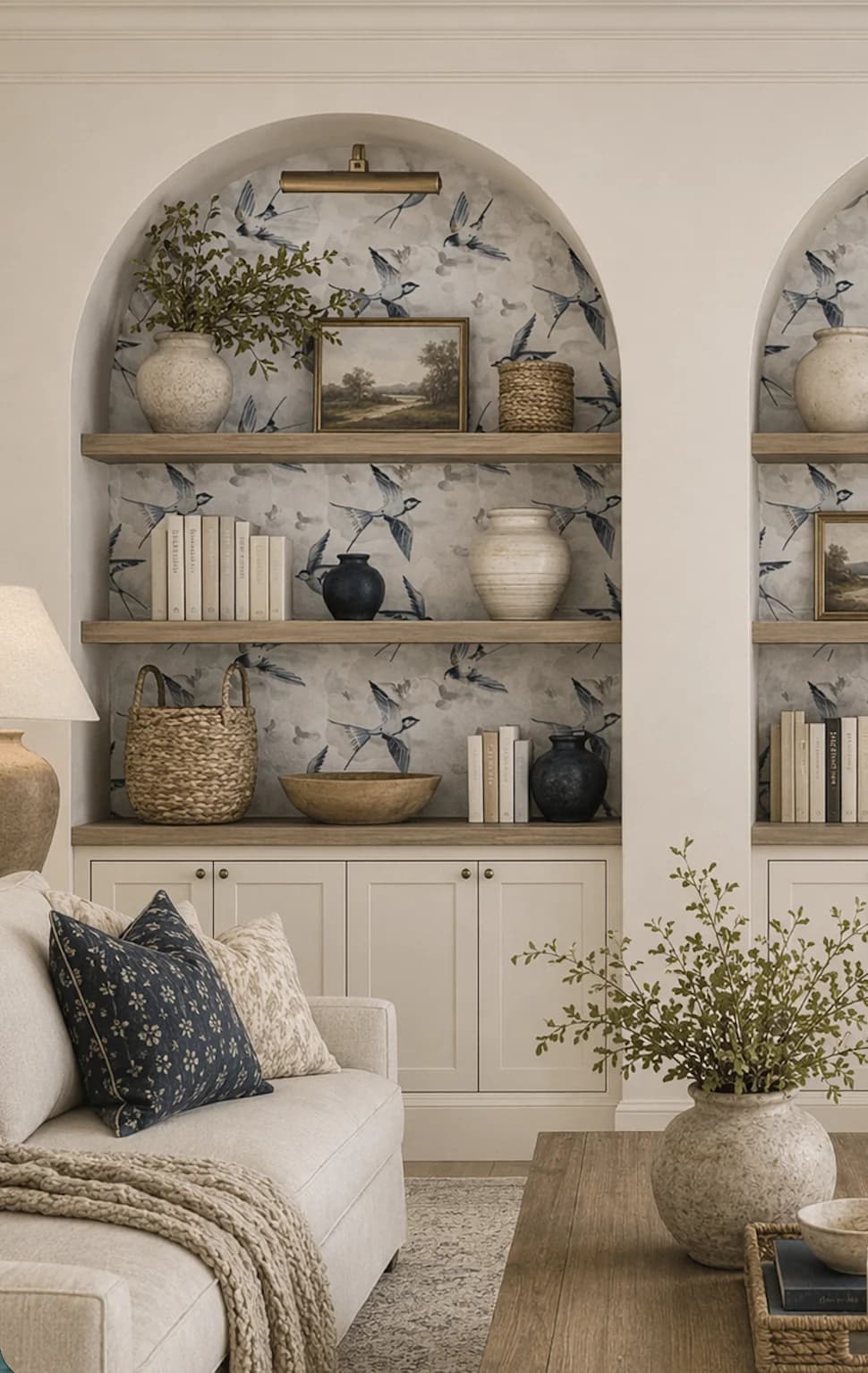
The Back of the Shelf
The back panel is the largest surface in a bookcase and usually the most ignored.
- Paint it a shade darker than the walls, or a contrasting color, so pale objects stand out.
- Paper it with wallpaper or a peel-and-stick paper. Pattern at the back means you need fewer objects in front.
- Match it to the wall and paint shelves, back and frame in one color. The unit recedes and the contents float. This is part of the approach in our guide to color drenching a living room.
On a rented or veneered bookcase, cut thin card or foam board to size, cover it with paper and wedge it in.
Specific Situations
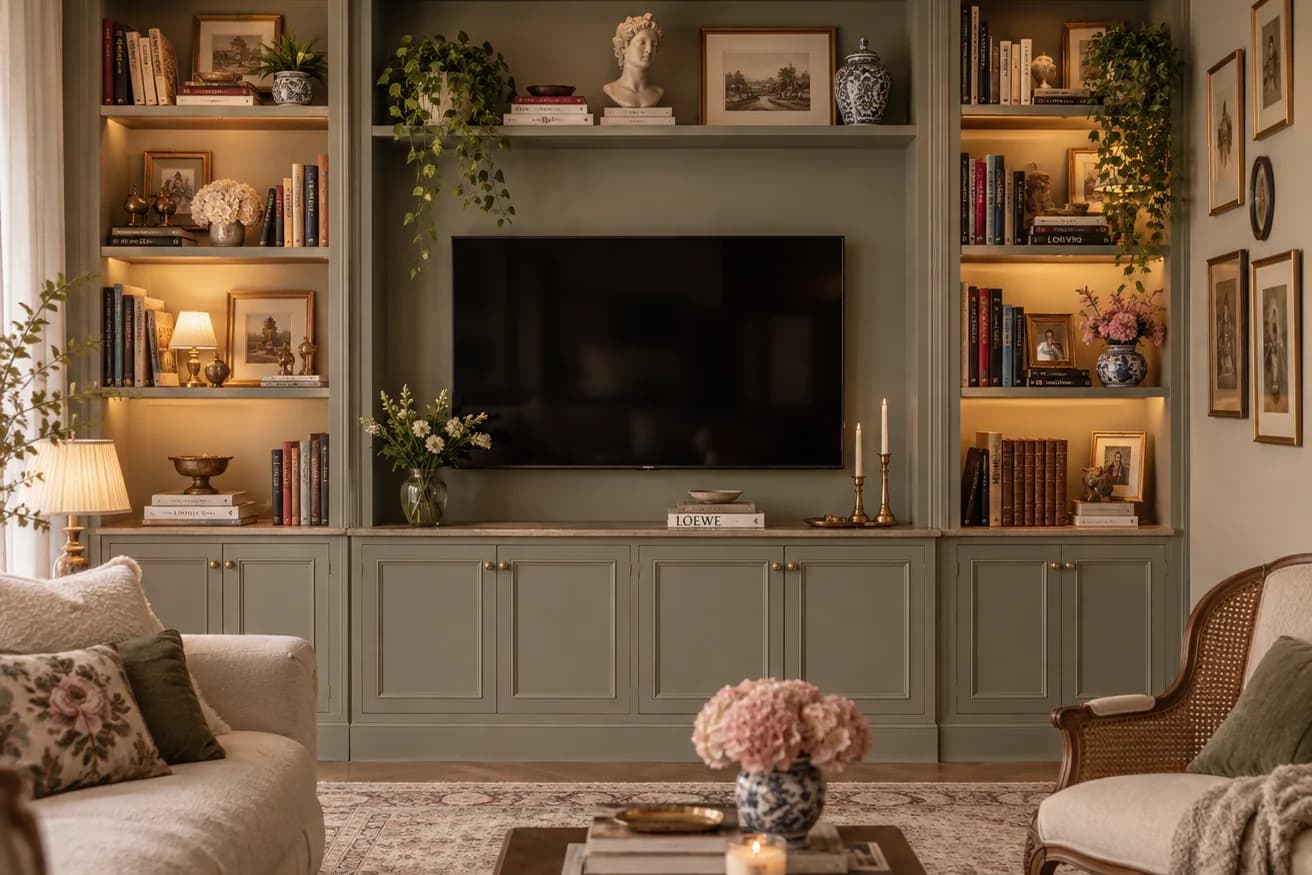
With a TV in the middle. Keep the shelves beside the screen quieter than the outer ones, with larger and fewer objects, so they do not compete while you watch. Mirror the two sides loosely: the same kinds of things, not identical ones.
With plants. Trailing plants high, upright plants low, and check the light: shelves far from a window suit very few plants. A pot without a drainage hole or a saucer protects the shelf.
With photos. Use frames in one finish, mix a few sizes, and overlap them slightly in one or two spots instead of dotting single frames everywhere. If you have more photos than shelf, a wall is the better home; see our gallery wall ideas for a hallway.
With baskets. Along the bottom, or one per bay on the top shelf for things used rarely. Measure the shelf depth and height before buying or rehoming any.
Minimalist. One to three items per shelf, one palette, and at least one shelf left almost empty. The restraint in our Japandi living room ideas is the model.
In a bedroom. Calmer and lower: books you are reading at hand height, closed boxes for clutter, nothing heavy above the pillow.
Seasonal changes. Keep the structure and swap two or three objects, as you would with the arrangement in our coffee table tray decor ideas.
Mistakes That Make Shelves Look Cluttered
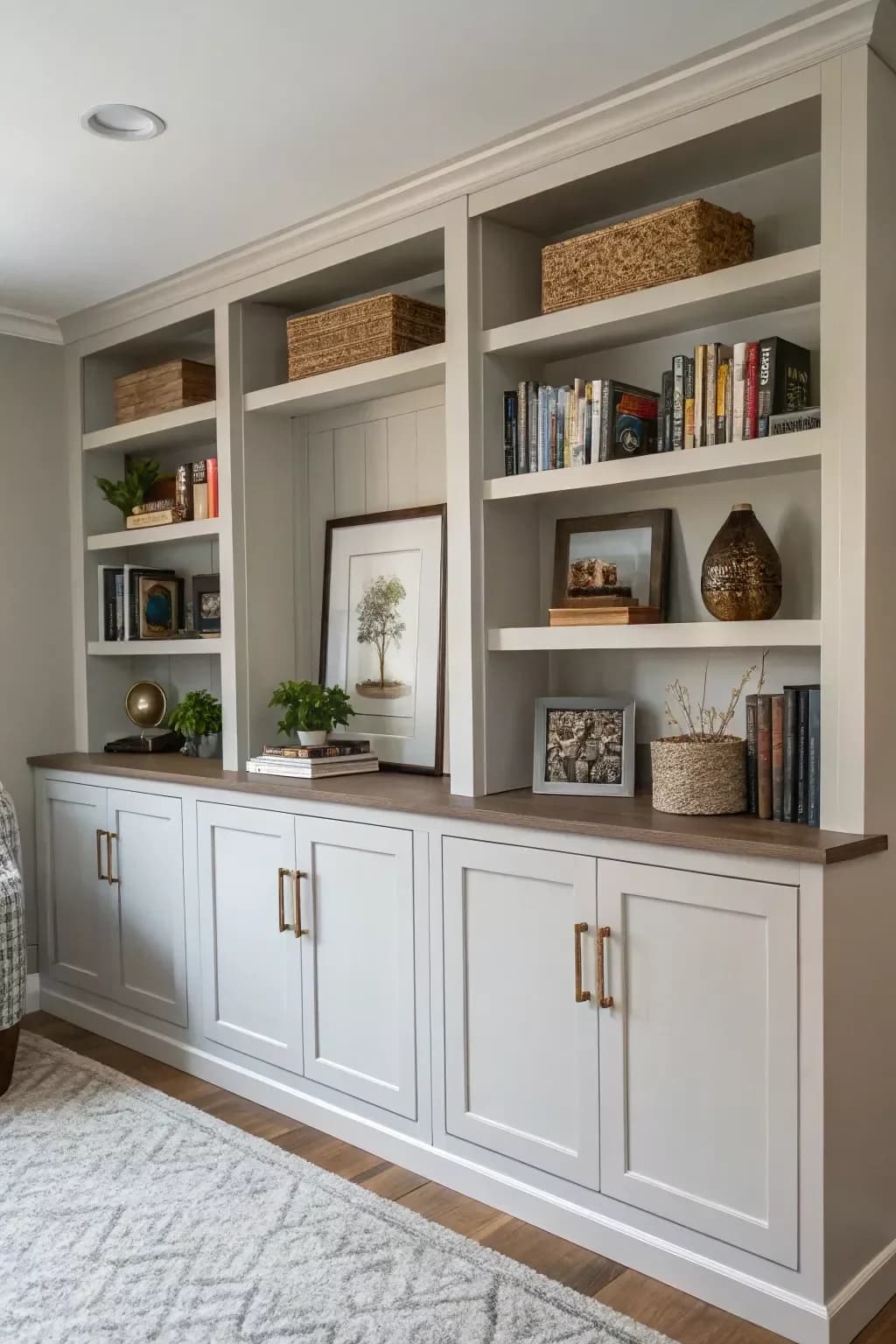
- Too many small things. The most common one. Fewer, bigger.
- Everything the same height. Lift something on a stack; lay something down.
- All the objects pushed to the back. Bring the front layer forward.
- One of everything. A single blue vase among neutrals looks accidental. Repeat it or remove it.
- Symmetry on every shelf. Balance across the whole unit matters more than a matched pair on each shelf.
- Cables and routers in view. Hide them in a lidded box with a notch cut for the wires.
If the real problem is that the shelves are holding everything you own, the fix is storage, not styling: our guide to how to organize a small apartment starts there.
FAQ
How do you style a bookshelf step by step?
Empty it, choose two or three repeating colors, place the largest pieces in a zigzag, add books upright and in flat stacks, layer art and small objects, add a plant, then remove a few things so each shelf has a gap.
How do you style a bookshelf without books?
Use a collection of related objects such as pottery, baskets or bowls, in a tight palette. Choose fewer, larger pieces, add framed art at the back, lift some objects on boxes, and leave whole sections empty.
How do I style a bookshelf with a lot of books?
Keep most books upright, add flat stacks at the ends of some rows, leave one or two open bays at eye level for a lamp or picture, and use the bottom shelf for large books or baskets.
Should books be vertical or horizontal on a shelf?
Both. Upright rows are the base; flat stacks of two to five books break them up and make a stand for an object.
How full should a bookshelf be?
As common guidance, about two thirds full. Some empty space on every shelf is what makes the arrangement look deliberate.
How do I style a bookshelf in a living room with a TV?
Keep the shelves next to the screen simple, with larger and fewer pieces, and put the more detailed arrangements on the outer shelves. Balance the two sides without matching them exactly.