7 Renter-Friendly Room Dividers to Separate Your Studio Apartment
Explore renter-friendly room divider ideas, from no-drill partition walls to floor-to-ceiling wall dividers and studio room separators, without losing your deposit.

Other languages:Españolالعربية
In this guide · 7 sections
If you want to separate your sleeping space from your living area without losing your security deposit, finding the right renter friendly room dividers is essential. Most tenants are bound by strict lease agreements that prohibit structural modifications, meaning drywall and heavy drilling are entirely out of the question.
This guide covers seven damage-free ways to partition a studio, grouped by design style, then how to install tension systems safely and how to plan your zones so a divider doesn’t block your only window.
Why No-Drill Room Dividers Work Best for Renters
For years, the standard advice for separating a studio apartment was to drag a heavy, blocky IKEA unit into the middle of the room. While functional, this often blocks precious natural light and creates a bulky footprint in an already cramped space.
Today’s renters demand more. You need no drill room dividers that offer visual separation without sacrificing aesthetic appeal.
By opting for damage-free solutions, you protect yourself from steep repair fees when moving out. Furthermore, modern modular and tension-based systems allow you to take your “walls” with you to your next apartment.
This portability makes high-quality dividers a brilliant long-term investment. A successful studio layout doesn’t just block off a bed; it creates distinct psychological zones that make your home feel expansive and purposeful.
Reader Poll
What is your biggest priority when dividing your studio?
7 Best Renter Friendly Room Dividers by Design Style
Below are 7 zero-damage options grouped by interior design style, so you can find a partition that blends into the look you already have. The “Our take” ratings are our editorial judgment of how much light each lets through, how much privacy it gives, and how much sound it dampens.
1. The Japandi Slatted Wood Tension Wall
If you want the look of custom millwork without picking up a power drill, slatted wood panels are the answer. Utilizing floor-to-ceiling tension rods, these dividers press firmly between your floor and ceiling.
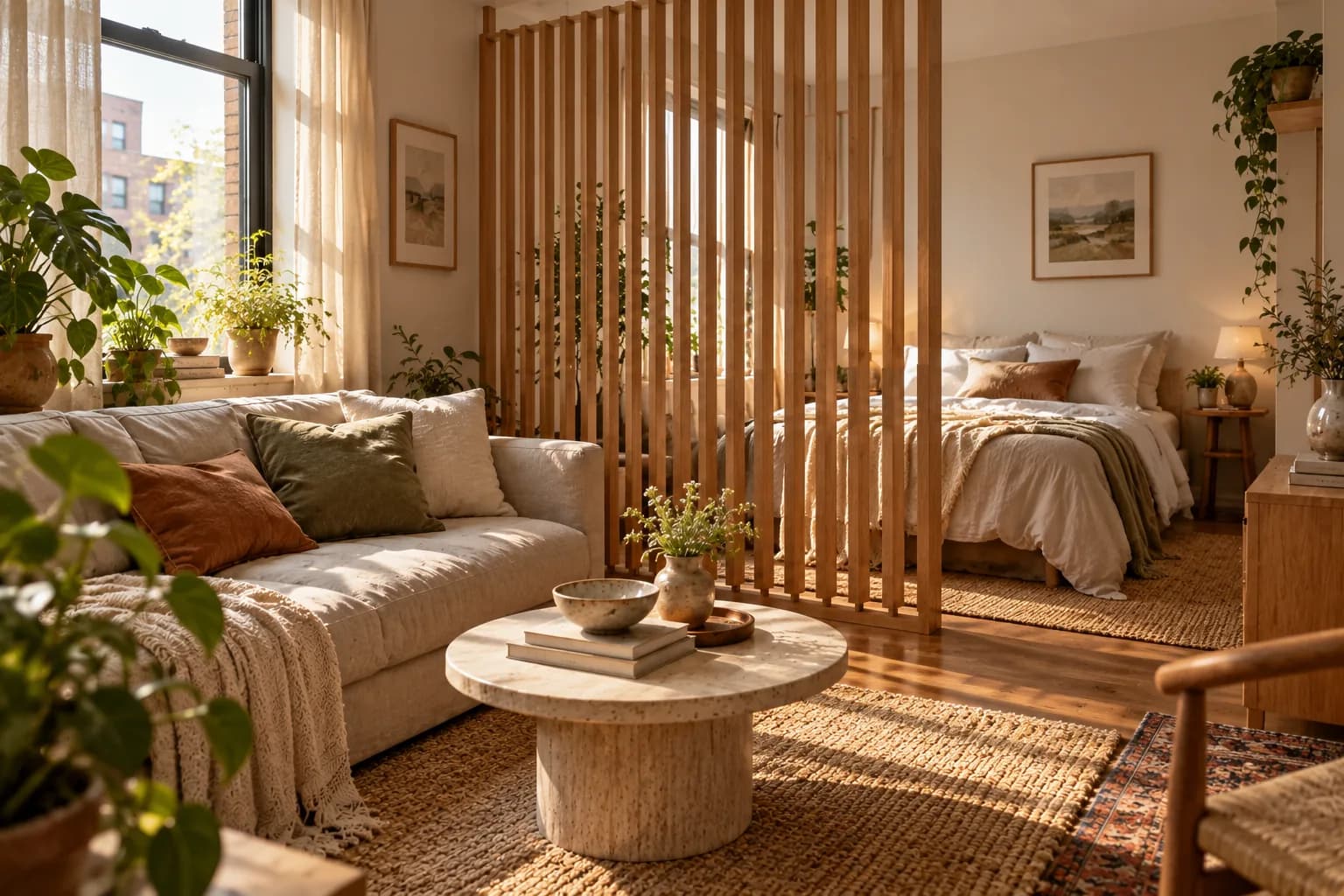
These panels are typically constructed using solid oak veneers over a lightweight MDF core, making them easy to maneuver. They are arguably the most effective tension rod room dividers for renters because the gaps between the wood slats allow sunlight to pass through. This makes them one of the most popular floor-to-ceiling room divider options for tenants who want structure without construction.
A slat wall system with adjustable rubberized feet that protect the ceiling, and no tools needed to put it up.
- Light
- Privacy
- Sound
- Looks built-in
- Zero floor footprint
- Lets daylight through
- Needs a solid, flat ceiling
- Not for popcorn or drop ceilings
2. Mid-Century Modern Modular Bookshelves
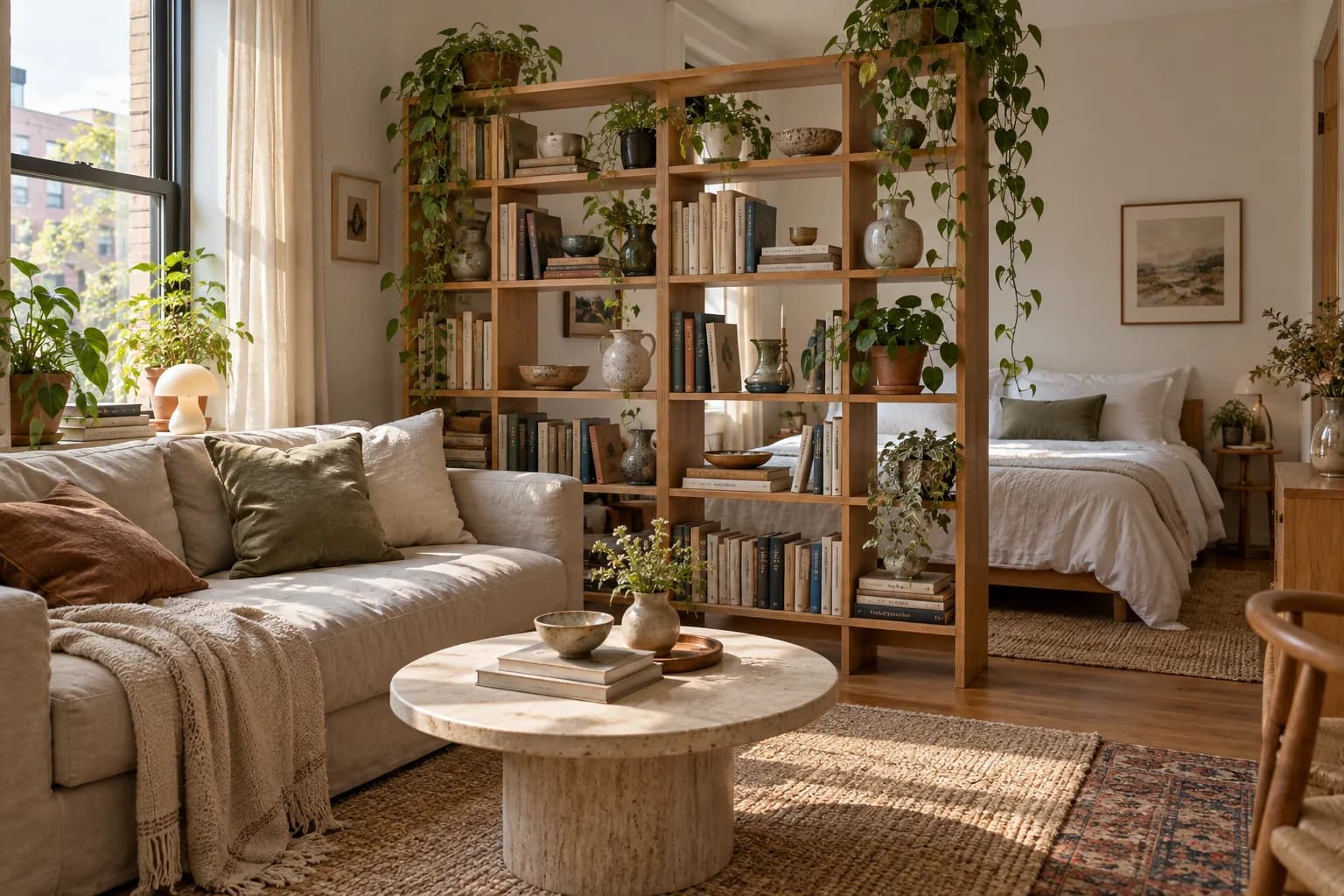
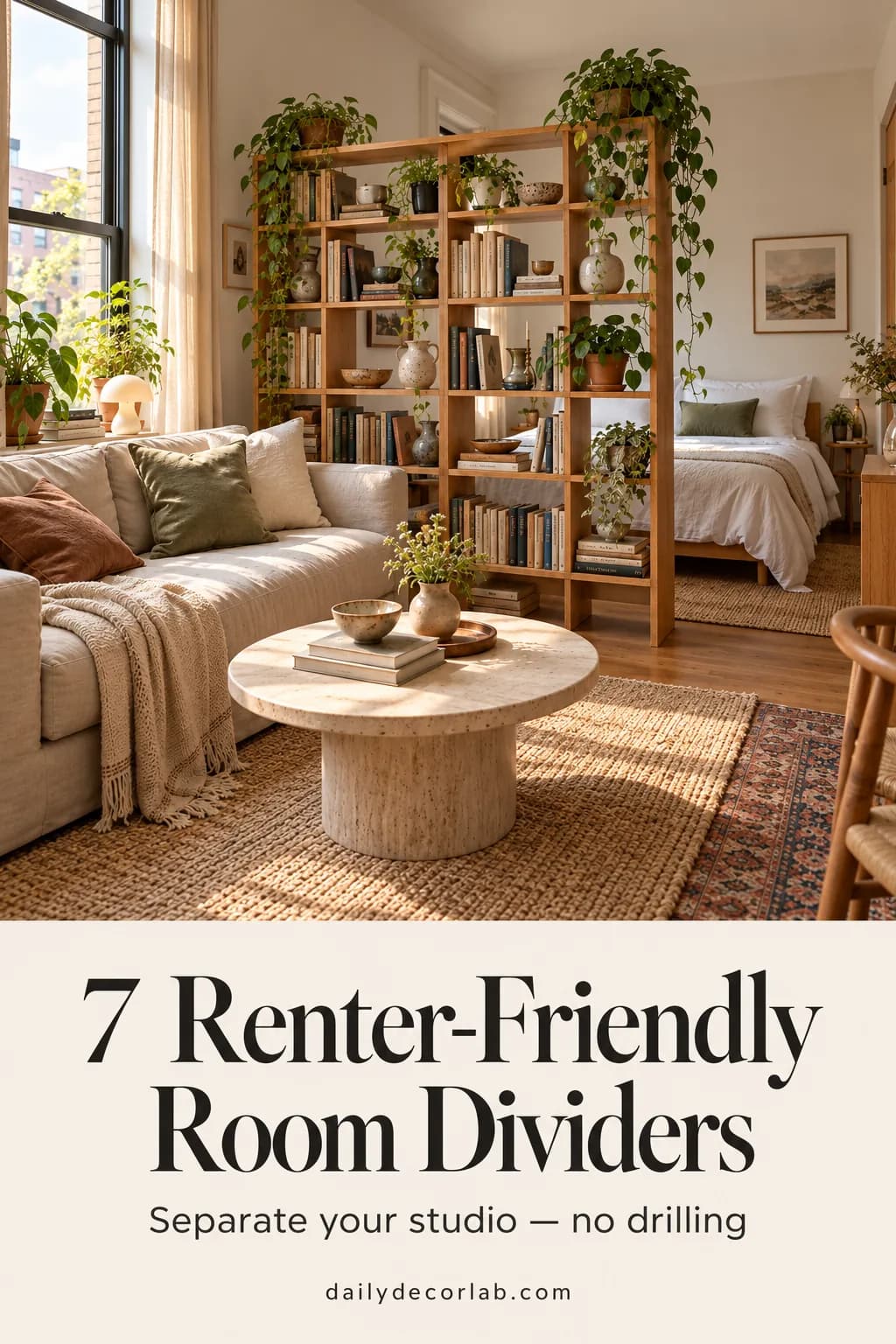
Rather than a basic cube organizer, look for open-backed, mid-century style étagères or modular shelving units. Because they don’t have a solid back panel, they won’t make your studio feel like a dark cave.
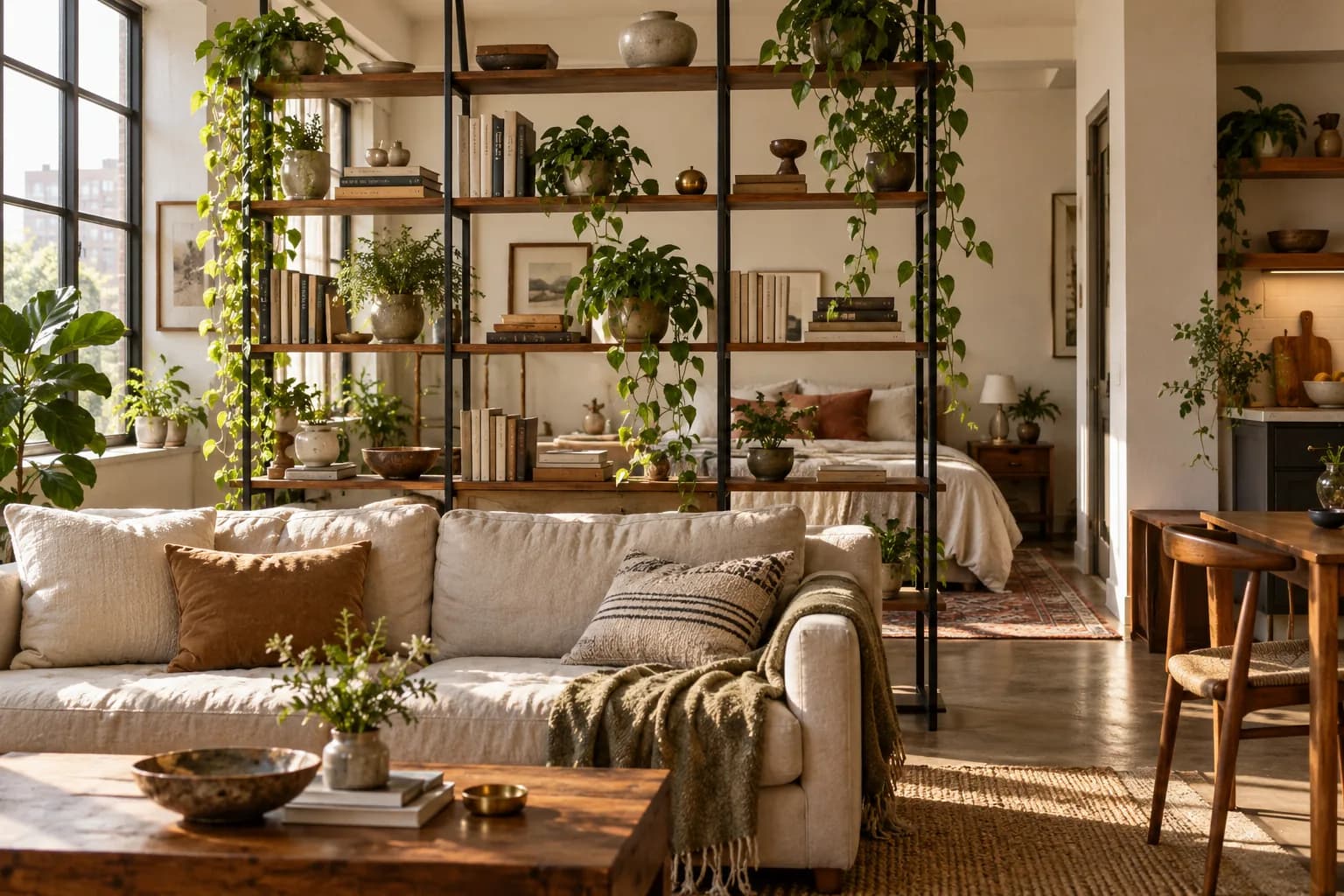
Constructed from powder-coated steel framing and walnut-finished wood, these shelves provide structural elegance. When searching for aesthetic freestanding room dividers , prioritize shelves with a staggered or geometric design to keep the eye moving.
The open-concept design of the Theo bookshelf provides ample storage for trailing plants and books while maintaining a bright, airy feel.
- Light
- Privacy
- Sound
- Storage and divider in one
- Display space for plants and books
- Stable on hard floors
- Uses more floor space than a flat screen
- Needs careful styling to avoid clutter
3. Minimalist Acoustic Panel Partitions
If your studio doubles as your office, you don’t just need visual separation—you need sound dampening. Freestanding acoustic panels, often used in modern corporate offices, have made their way into residential design.
Crafted from high-density, recycled PET felt fabric, these studio apartment room dividers absorb echoes and keyboard clacking. They are supported by lightweight aluminum framing and low-profile feet that slide easily under your desk or sofa.
This tackable privacy screen features sturdy metal feet and excellent sound-absorbing properties for your WFH setup.
- Light
- Privacy
- Sound
- Absorbs echo and keyboard noise
- Light and easy to move
- Doubles as a pinboard
- Fully opaque, so place it away from windows
4. The Industrial Crittall-Style Glass Screen
Crittall-style (black metal-framed glass) walls are incredibly popular, but installing real glass partitions requires heavy construction. Fortunately, you can achieve this look with freestanding, paneled screens.
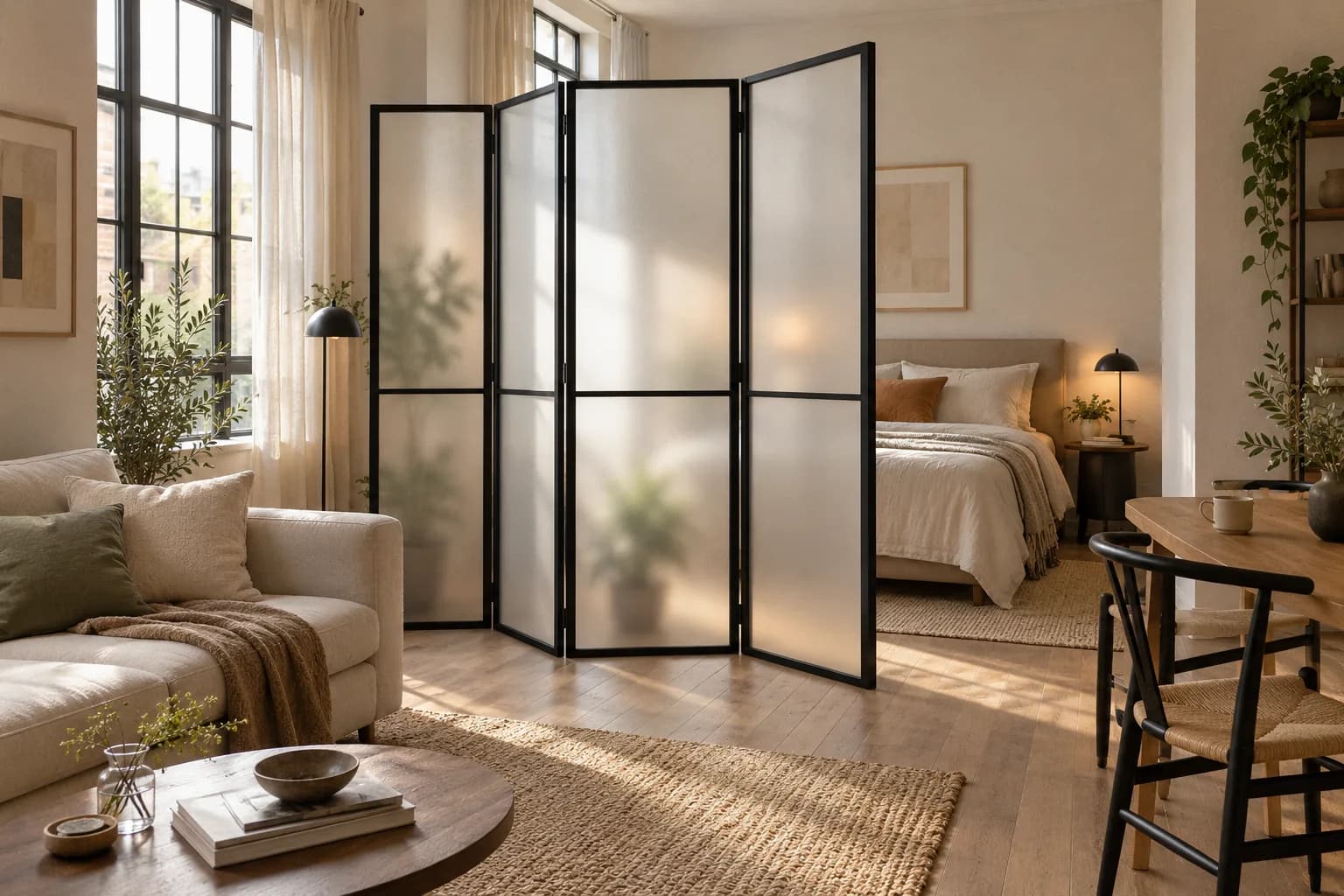
These screens are manufactured using shatter-proof frosted polycarbonate or acrylic set inside matte black aluminum frames. They act as perfect renter friendly temporary walls because they fold up accordion-style, bouncing light around the room to make it feel twice as large.
Offering the perfect blend of privacy and light transmission, this folding screen gives you a Brooklyn loft vibe instantly.
- Light
- Privacy
- Sound
- Transmits light beautifully
- Folds flat for storage
- Instant architectural character
- Panels scratch if bumped by pets or furniture
5. Contemporary Curved Fluted Panels
Corrugated or fluted textures are having a major moment in interior design. You can purchase sweeping, curved room dividers made of heavy-duty craft paper or fluted polycarbonate.
These freestanding room dividers feature a brilliant honeycomb structure that allows them to stretch out to create a wall. When you want to open up the space for hosting, they fold back into a tiny, unobtrusive column.
Made from eco-friendly, water-resistant kraft paper, this sculptural divider curves to fit any awkward studio layout.
- Light
- Privacy
- Sound
- Sculptural and unusual
- Folds into a small column
- Very light
- Paper doesn’t like moisture
- Not for homes with scratchy pets
6. Boho-Chic Macramé Hanging Panels
If you are looking for cheap room partitions , suspended macramé panels are highly cost-effective and visually stunning. Woven using 100% natural cotton cord and suspended from wooden dowels, they add instant warmth.
You can hang these using heavy-duty adhesive ceiling hooks or an adjustable tension rod placed within an alcove. The intricate knotting effectively blurs the lines between the living area and the bedroom without building a solid blockade.
This beautifully hand-woven panel adds incredible texture to a bohemian space at a fraction of the cost of rigid walls.
- Light
- Privacy
- Sound
- Very budget-friendly
- Soft, warm texture
- Easy to hang and move
- Visual separation only, no privacy or sound blocking
- Needs ceiling hooks or a tension rod
7. The Classic Linen Drapery Wall
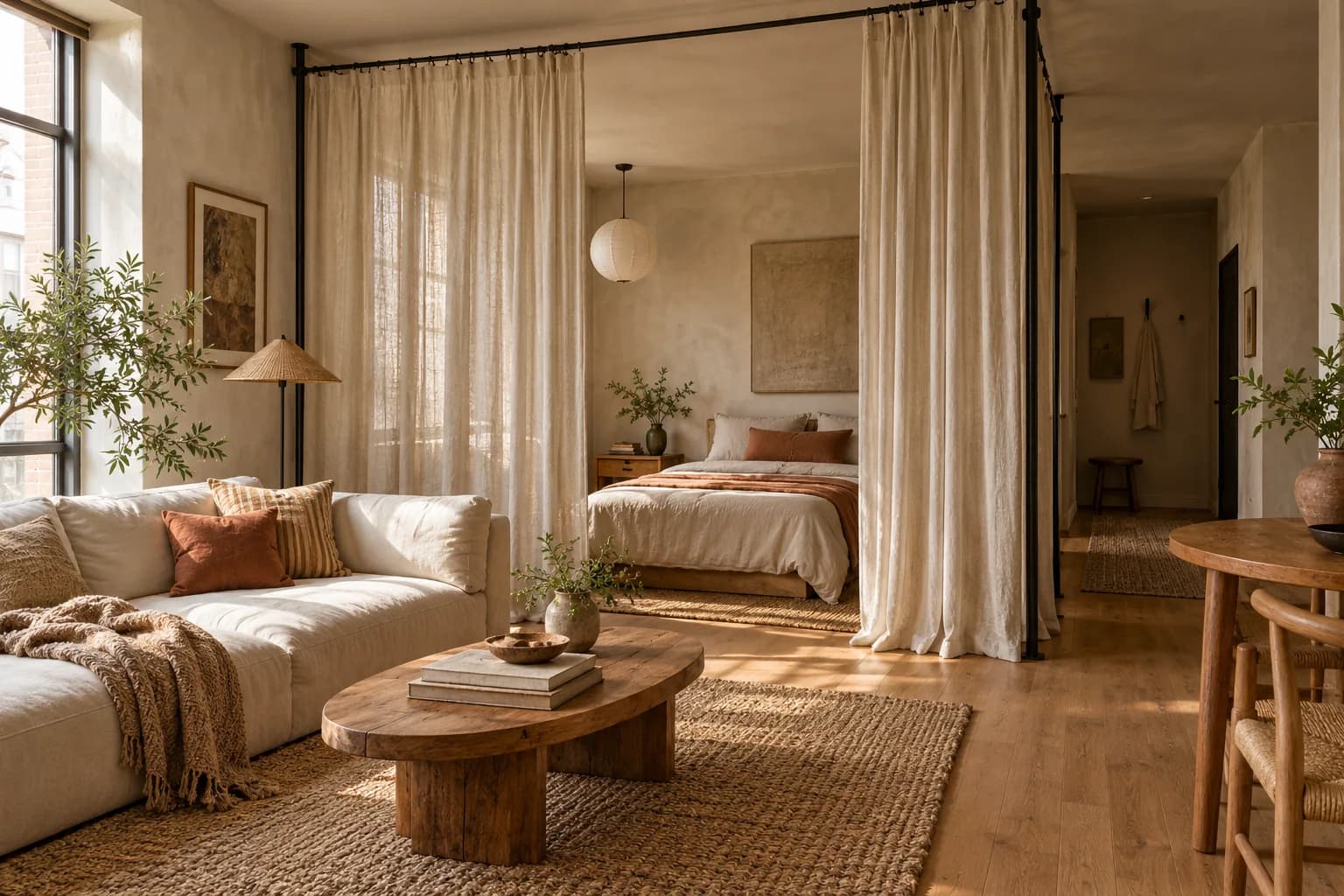
Sometimes, the simplest solution is the most elegant. A floor-to-ceiling curtain installed via an extra-long, rust-resistant steel tension rod can completely transform a room.
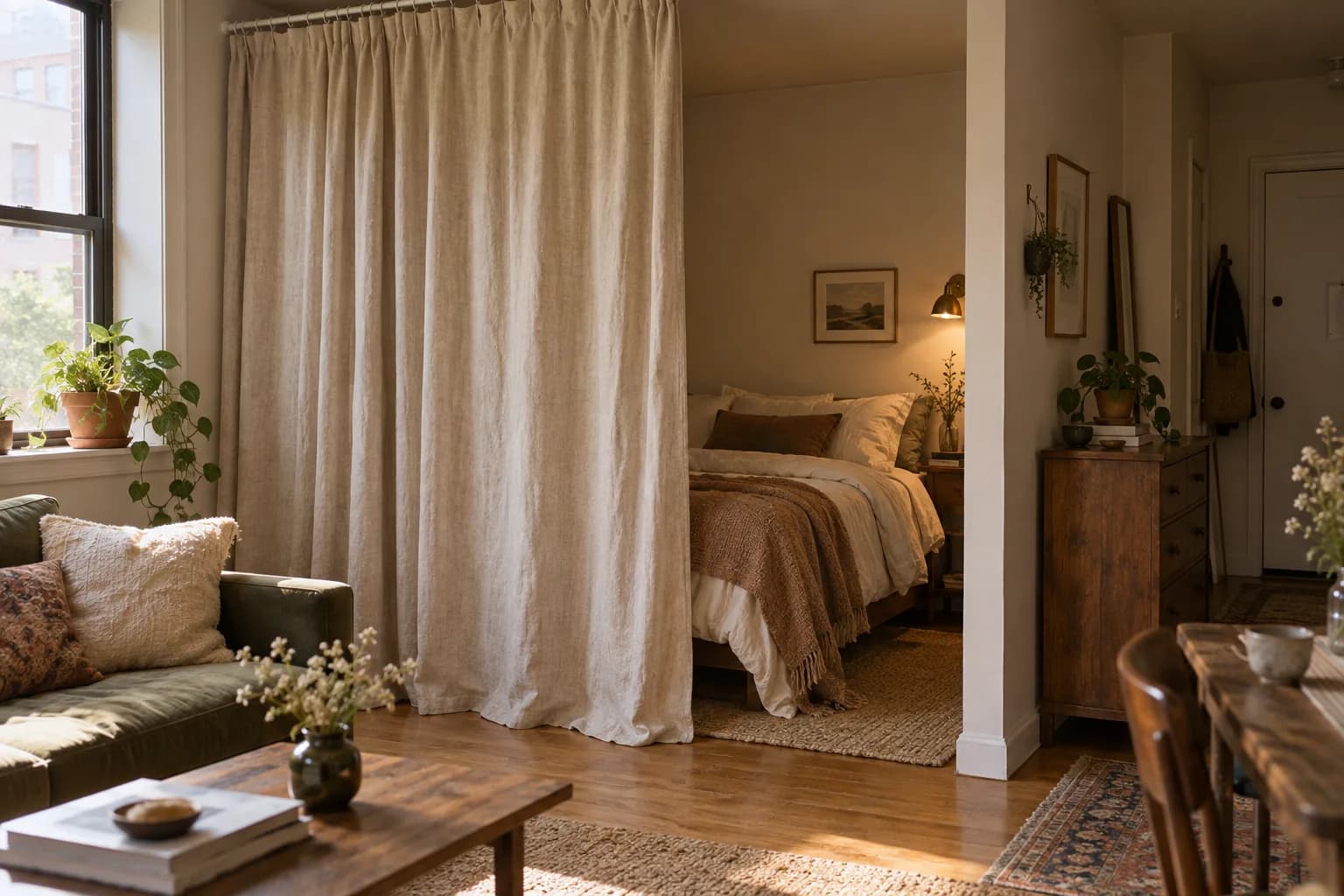
For the most luxurious look, avoid cheap synthetic fabrics. Instead, utilize the diy drop cloth curtains method to create high-end, heavy linen-textured drapery. When open, they add softness to the room; when closed, they create a private sleeping nook.
How to Install a Floor-to-Ceiling Tension Divider Safely
When installing any tension-based divider, safety and damage prevention are paramount. Because these systems rely on sheer pressure to stay upright, a poor installation can lead to a collapsed wall or chipped ceiling paint.
First, always measure your floor-to-ceiling height accurately. Most tension rods have a maximum reach, and extending them to their absolute limit severely weakens their weight-bearing capacity. Always purchase a rod that extends at least one foot longer than your actual ceiling height.
Second, protect your landlord’s paint job. Even if a product claims to have non-slip rubber feet, you should apply standard felt furniture pads to the top contact points. This simple hack prevents the rubber from fusing with the ceiling paint over time.
Finally, tighten the system gradually. Use a level to ensure the vertical poles are perfectly plumb. Check the tension once a month, as temperature changes in your apartment can cause metal rods to contract slightly, loosening their grip.
How to Divide a Studio Apartment Without Building Walls
Buying the physical divider is only half the battle. Learning how to divide a studio apartment without building walls effectively comes down to strategic floor planning and understanding light flow.
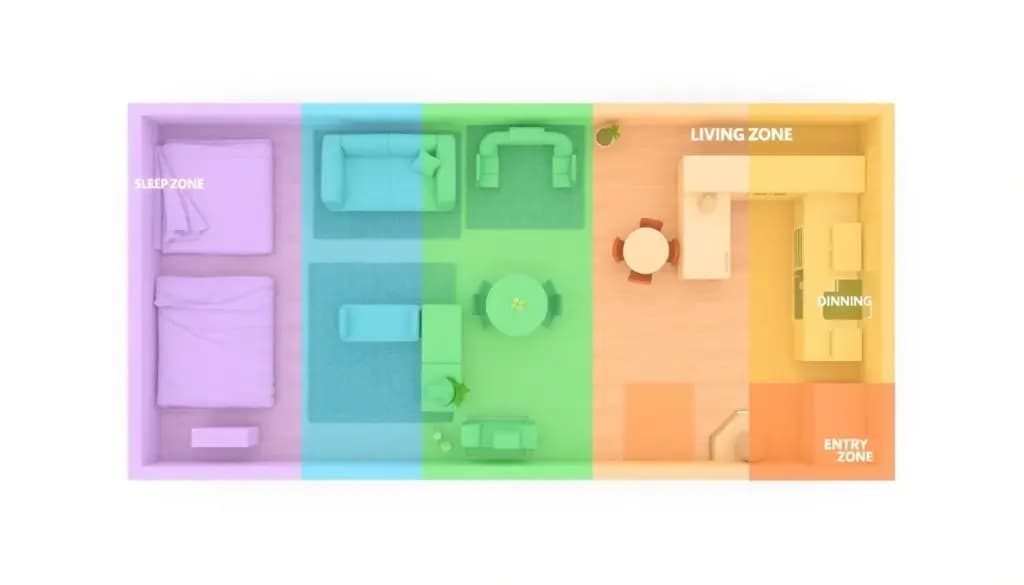
Map Out Your “Zones”
Before placing your partition, identify the natural zones of your apartment. Look at where the natural light hits. Ideally, your living and working zones should be closest to the windows, allowing you to maximize daylight during working hours.
If your apartment is particularly gloomy, you should read up on how to maximize lighting in a dark apartment before placing any tall dividers. Your sleeping zone can be safely tucked into the darker recesses of the layout since you primarily use it at night.
Avoid the Perimeter Trap
The biggest mistake renters make when trying to partition a room is pushing all their furniture against the walls to “make space” in the middle. They then throw a divider directly in the center, creating a claustrophobic box.
Instead, you need to learn proper small apartment furniture placement. By floating your sofa in the middle of the room and placing a low bookshelf or acoustic panel directly behind it, you create a natural corridor that makes the apartment feel like a one-bedroom.
Carving Out an Entryway
Many studio apartments open directly into the main living or sleeping space, which can feel incredibly jarring. You can use a narrow slatted divider to create an artificial foyer right at the front door.
Pair it with a slim console table, a catch-all tray, and some renter-friendly removable wallpaper on the adjacent wall. Implementing these clever small apartment entryway ideas instantly establishes a welcoming sense of arrival.
Temporary Walls for Renters: What to Look For
Not all renter friendly room dividers are created equal, and the right choice often comes down to whether you want a solid renter friendly partition wall or a lighter, more decorative renter friendly wall divider. When shopping for your apartment, compare your options on these five points.
| Divider Type | Visual Weight | Light Flow | Sound Dampening | Estimated Budget |
|---|---|---|---|---|
| Tension Slats | Medium | Excellent | Low | $$ |
| Open Bookshelf | Heavy | Moderate | Low | $$$ |
| Acoustic Panel | Medium | Poor | Excellent | $$ |
| Glass/Acrylic Screen | Light | Excellent | Low | $$$ |
| Curtain/Drapery | Light to Heavy | Variable | Moderate | $ |
Key Buying Criteria:
- Weight Base: If buying a freestanding screen, ensure the feet are wide and weighted. Tall screens easily tip over on plush apartment carpeting.
- Adjustability: Tension rods must have at least a 2-inch variance to account for uneven apartment floors, which are common in older buildings.
- Portability: Can it fold flat? If your lease is up in 12 months, you want something that easily fits into the back of a moving van.
Frequently Asked Questions
How do you divide a room without damaging walls?
The safest way to divide a room without damage is by using freestanding screens, heavy-bottomed bookcases, or floor-to-ceiling tension rod systems. These options rely on gravity and pressure rather than screws and nails, leaving your drywall and paint completely intact.
Are temporary walls legal in apartments?
Yes, most freestanding and tension-based temporary walls for renters are perfectly legal because they are considered furniture rather than structural modifications. However, pressurized “true walls” that block egress (exit routes) or interfere with sprinkler systems violate fire codes. Always ensure your divider does not block your main exit or windows.
How can I partition a room cheaply?
The most budget-friendly way to partition a room is by hanging a tension rod across a nook or using adhesive ceiling hooks to suspend inexpensive textiles. Utilizing drop-cloth linen curtains or macramé panels allows you to easily achieve a beautiful look for under $50.
What is the best way to divide a studio apartment?
The best approach is to use a semi-permeable divider—like an open-backed étagère or a slatted wood screen. This creates a psychological boundary between the living and sleeping zones while allowing natural light and airflow to circulate freely throughout the entire apartment.
Do tension rods work well as room dividers?
Yes, heavy-duty tension rods are excellent room dividers. When purchased in the correct weight capacity (look for rods rated for 20+ lbs), they can easily support heavy blackout curtains or specialized wooden slat systems without slipping or causing ceiling damage.
What can I use as a room separator in a studio apartment?
Anything that stands on its own or presses between floor and ceiling: an open-back bookshelf, a folding screen, a tension-rod curtain, a slatted tension wall, or a freestanding acoustic panel. Pick by what you need most. Shelves add storage, slats and acrylic keep the light, curtains and acoustic panels give the most privacy.
How do I separate my bed from my living room in a studio?
Place your bed in the corner furthest from the entrance. Float your sofa at the foot of the bed, facing away from the sleeping area. Place a low-profile aesthetic freestanding room divider or a console table directly behind the sofa to establish a clear visual boundary.
What’s the difference between a partition wall and a wall divider?
A renter friendly partition wall typically refers to a solid, floor-to-ceiling structure (like a tension slat wall or acoustic panel) that fully blocks a space off. A renter friendly wall divider is often a lighter, more decorative option, such as an open bookshelf, curtain, or macramé panel, that separates a room visually without fully closing it in. Both are damage-free and require no drilling.
Ready to Transform Your Studio?
Living in a single room doesn’t mean you have to sacrifice privacy, style, or your security deposit. By choosing elevated, renter friendly room dividers —like Japandi slatted tension walls, mid-century open shelving, or sleek acoustic panels—you can completely change your daily living experience.
Once your zones are defined, seasonal styling gets much easier — our fall decor ideas for small apartments covers how to dress each zone without adding clutter. Stop pushing your bed into the corner in plain sight and settling for a cramped aesthetic. Evaluate your natural light, measure your ceiling height, and invest in a zero-damage partition today. Then go back to the picks above and choose the one that matches how you actually use the room.